
Why SEO Matters For Roofing Companies
Roofing companies depend heavily on local visibility. A homeowner with a leaking roof is not searching for entertainment. A landlord with storm damage is not browsing casually. A commercial property manager looking for a roof inspection has a real need. These people are searching with intent — they want a roofing company that is local, trustworthy, responsive and qualified. If your roofing business does not appear when they search, competitors get the opportunity first.
Roofing SEO helps you compete locally
SEO helps your roofing company appear in search results for services and locations you want to target. This may include searches such as:
- roof repair in [city]
- roofing contractor near me
- emergency roof leak repair
- flat roofing company in [location]
- roof replacement estimate
- metal roofing contractor
- gutter installation near me
- storm damage roofing company
Roofing SEO builds long-term visibility
Paid ads can generate leads quickly, but once the budget stops, the traffic stops. SEO takes longer, but it can build long-term visibility. A strong roofing website with optimized service pages, location landing pages, reviews, helpful content and authority can continue bringing enquiries over time.
SEO does not replace paid ads for every roofing company, but it can reduce the pressure of depending only on paid traffic. For a full breakdown of how organic SEO compounds over time, see our /organic-seo service page.
SEO builds trust before the call
Roofing customers often compare several companies before contacting one. They may look at Google reviews, website quality, photos of past work, service pages, location coverage, years in business, certifications, insurance information, testimonials, response speed and quote process. SEO helps more people find your roofing company — but your website and Google profile must also make them feel confident enough to contact you.
How Roofing Customers Search On Google
Roofing customers use different types of searches depending on their problem. Understanding these searches helps you build better SEO pages.
Emergency roofing searches
These searches usually come from people who need urgent help — examples include emergency roofer near me, roof leak repair near me, leaking roof repair in [city], storm damage roof repair and emergency roof repair company. These searches often lead to phone calls, so your website and Google profile should make calling easy.
Service-specific roofing searches
These come from people looking for a specific roofing service — roof replacement company, flat roof repair, tile roof repair, slate roof repair, metal roofing contractor, gutter repair, chimney flashing repair and roof inspection service. Each major service should have its own optimized page.
Location-based and research-based searches
Location searches include a city, town, suburb or service area — roofing company in Manchester, roofer in Birmingham, roof repair in Leeds, commercial roofing contractor in London. Research-based searches come from people who are not ready to call yet but are learning — how much does roof replacement cost, signs you need a new roof, what causes roof leaks, flat roof repair vs replacement. Blog content can attract these users and guide them toward your services.
Brand searches
Once people discover your business, they may search for your brand — [company name] reviews, [company name] roofing, [company name] roof repair, [company name] contact. Good SEO also protects and improves your brand search presence.
Why Local Leads Are Different From General Website Traffic
Not all traffic is equal. A roofing company does not need visitors from everywhere — it needs visitors from the areas it serves. A roofing company in Birmingham does not need traffic from New York. A local roofing contractor does not need thousands of visitors if none of them can become customers.
Local SEO focuses on the right people
Local roofing SEO targets people who are in your service area, searching for roofing services, ready to call or request a quote, comparing roofing companies, looking for local trust signals and interested in your specific roofing solutions. This is why local intent matters more than broad traffic.
For example, a blog post about "roofing history" may get visitors but rarely generate leads. A page targeting "emergency roof repair in [city]" may get fewer visitors, but those visitors are far more likely to call. For roofing companies, quality matters more than volume.
Local leads usually need fast action
Roofing leads often come with urgency — leak repair, storm damage inspection, missing tile replacement, emergency tarping, gutter repair, roof inspection before selling a property or commercial roof maintenance. Your SEO strategy should make it easy for these users to take action quickly.
Google Maps SEO For Roofing Companies
Google Maps can be one of the most important lead sources for roofing companies. When people search "roofer near me" or "roof repair near me," Google often shows a local map pack near the top of the results. This map section can influence which roofing company gets the call.
Why Google Maps matters
The map pack usually shows business name, reviews, star rating, category, location, phone button, website link, directions, opening hours, photos and service details. Many users make decisions directly from this section. If your roofing company is not visible in Google Maps, you may lose local leads to competitors with stronger profiles. Our /google-map-seo service focuses specifically on winning the 3-pack for roofing and service businesses.
What influences Google Maps visibility
Google Maps visibility can be influenced by relevance, distance and prominence, plus Google Business Profile categories, reviews, review quality, review recency, service areas, website local SEO, citations, local backlinks, profile completeness, business photos, user engagement and local content. You cannot control every factor, but you can improve many signals that help your business appear more trusted and relevant.
Roofing map pack searches to target
Roofing companies should monitor searches such as roofer near me, roof repair near me, roofing company near me, emergency roofer near me, flat roof repair near me, gutter repair near me, roofing contractor in [city] and roof replacement in [city]. These are often high-value local searches.
Google Business Profile Optimization For Roofers
Your Google Business Profile can influence both rankings and conversions. Before someone visits your website, they may review your profile. A weak profile can reduce trust. A strong profile can help turn searches into calls. For a full walkthrough, read our /blog/google-business-profile-optimization guide.
What to optimize
Your roofing Google Business Profile should include correct business name, accurate phone number, website link, primary category, secondary categories, roofing services, service areas, opening hours, business description, photos, videos, reviews, review responses, Q&A section, posts and updates, and appointment or quote links where relevant.
Category and services setup
Choosing the right primary category is important — roofing companies should make sure their category accurately reflects the business. Secondary categories may support related services if they are genuinely offered. Avoid adding unrelated categories just to chase visibility.
Add roofing services clearly — roof repair, roof replacement, emergency roof repair, flat roofing, tile roofing, slate roofing, metal roofing, commercial roofing, gutter installation, gutter repair, roof inspection and storm damage repair. This helps customers and Google understand what you provide.
Photos, proof and review responses
Photos are powerful for roofers — add real images of completed roofing projects, before and after work, team members, vans, equipment, roof inspections, office or yard, branded uniforms and safety setup. Real photos build trust; do not rely only on stock images.
Responding to reviews shows that your business is active and professional. Review responses should be natural, helpful and respectful. Do not stuff keywords unnaturally, do not use fake reviews and do not offer incentives that violate review guidelines.
Roofing Keyword Research
Keyword research helps roofing companies understand what local customers actually search. The goal is not to target every roofing keyword — it is to target the keywords that can bring qualified leads.
Core, service and location keywords
Main roofing keywords include roofing company, roofer near me, roofing contractor, roof repair, roof replacement, emergency roofer, roof inspection, commercial roofing and residential roofing.
Service keywords include flat roof repair, tile roof repair, slate roof repair, metal roof installation, gutter repair, gutter installation, chimney flashing repair, storm damage roof repair and roof leak repair.
Location keywords include roofer in [city], roofing company in [city], roof repair in [city], roof replacement in [city], emergency roofer in [city] and commercial roofer in [city].
Problem-based and commercial-intent keywords
Problem-based keywords include why is my roof leaking, signs of roof damage, how much does roof repair cost, should I repair or replace my roof, what to do after storm damage and how long does a roof last.
Commercial-intent keywords are especially important because users may be closer to taking action — best roofing company near me, roof repair quote, roof replacement estimate, licensed roofing contractor, insured roofer near me and emergency roof repair company. A good roofing SEO strategy includes a mix of service, location, problem and commercial-intent keywords.
Roofing Service Pages That Generate Leads
Many roofing websites make the mistake of having one generic services page. That is usually not enough. Each major roofing service should have its own dedicated page. Dedicated service pages help Google understand what you offer and help customers find the exact service they need.
Important roofing service pages
Depending on your business, you may need pages for:
- Roof Repair
- Roof Replacement
- Emergency Roof Repair
- Roof Leak Repair
- Flat Roofing
- Tile Roofing
- Slate Roofing
- Metal Roofing
- Commercial Roofing
- Residential Roofing
- Gutter Repair
- Gutter Installation
- Fascia & Soffits
- Chimney Flashing Repair
- Storm Damage Roofing
- Roof Inspection
- Roof Maintenance
What each service page should include
A strong roofing service page should include a clear H1, a service explanation, common problems solved, signs the customer needs this service, your process, materials or roof types handled, service areas, trust signals, reviews, FAQs, before-and-after images where possible, internal links to related services and a clear call-and-quote CTA.
For example, a roof repair page should explain common roof repair issues, types of leaks repaired, emergency repair availability, inspection process, repair vs replacement guidance, local areas served, why choose your roofing company and how to request a quote. This is much stronger than simply saying "we offer roof repairs."
Location Pages For Roofing Companies
Location pages help roofing companies rank in different cities, towns, suburbs or service areas — but these pages must be useful. Thin copied location pages rarely perform well long term.
Why location pages matter
A roofing company may serve multiple areas — roofing company in Birmingham, roof repair in Coventry, roofer in Wolverhampton, flat roofing in Solihull, emergency roofer in Walsall. Each location may have search demand, and location pages help target those searches.
What a strong roofing location page should include
A strong location page should include a location-specific H1, roofing services offered in that area, common roofing problems in that area, nearby service areas, local reviews where available, project examples where available, a clear phone number, quote request CTA, internal links to roofing service pages, FAQs and LocalBusiness schema where appropriate.
Avoid copy-paste city pages
Do not create dozens of pages where only the city name changes — Google may see those as low-value pages. Each location page should provide genuine local usefulness. For competitive areas you may need more specific pages such as roof repair in [city], emergency roof repair in [city], flat roofing in [city], commercial roofing in [city] and roof replacement in [city] — but only when there is enough search demand and content value.
Technical SEO For Roofing Websites
Technical SEO helps search engines crawl, index and understand your website — and it improves user experience. This matters because many roofing customers search on mobile and want quick answers. For a full audit walkthrough, see our /blog/technical-seo-audit-guide.
Important technical SEO areas
Roofing websites should review mobile usability, page speed, Core Web Vitals, crawlability, indexing, XML sitemap, robots.txt, canonical tags, broken links, redirects, duplicate content, URL structure, heading structure, image size, schema markup, contact form functionality, HTTPS security and click-to-call buttons.
Speed, mobile and indexing
If a homeowner has a leaking roof, they will not wait for a slow website — a slow website can lose leads. Page speed affects user experience and can also influence SEO performance. Many local roofing searches happen on mobile, so your website should make it easy to call, request a quote, view services, check service areas, read reviews, see photos and submit a form.
Important roofing pages must be indexed. If Google does not index your roof repair page, it cannot rank. Check Google Search Console for crawled but not indexed, discovered but not indexed, duplicate pages, canonical issues, noindex problems and sitemap problems. Technical SEO is the foundation that supports the rest of your roofing SEO strategy — see /services/technical-seo for how we handle this.
Roofing Content Strategy
Content helps roofing companies answer customer questions, build trust and support service page rankings. Not every visitor is ready to call immediately — some need education first. Good content can help move them closer to contacting you.
Blog topics for roofing companies
Useful roofing blog topics may include:
- How do I know if my roof needs repair?
- Roof repair vs roof replacement: which one do I need?
- What causes roof leaks?
- How much does roof repair cost?
- What should I do after storm damage?
- How long does a roof last?
- What are the signs of roof damage?
- How often should I get my roof inspected?
- What is the best roofing material for my home?
- How to choose a roofing contractor
Content should support service pages
Blogs should internally link to relevant service pages. For example, a blog about "signs of roof damage" should link to Roof Repair, Roof Inspection, Emergency Roof Repair and Roof Replacement. This helps users and search engines.
Local roofing content
Local content can help build relevance — common roofing problems in [city], how weather affects roofs in [location], roof repair guide for homeowners in [city], best time of year to replace a roof in [region] and storm damage roofing checklist for [location]. This content should be useful, not just city-name stuffing. Roofing is a trust-based service, and helpful content shows that your company understands customer problems.
Reviews, Trust Signals & Reputation SEO
Reviews play a huge role in roofing lead generation. When customers compare roofing companies, they often look at reviews before calling. Reviews can influence trust, Google Maps performance, click-through rate, conversion rate, local reputation and customer confidence. See our /client-reviews page for examples of how we present social proof.
What to improve
Roofing companies should focus on getting genuine customer reviews, responding to reviews, displaying reviews on the website, encouraging service-specific reviews, building review consistency, monitoring review platforms and addressing negative reviews professionally.
Trust signals on roofing websites
Add trust signals such as years of experience, insurance information, certifications where accurate, accreditations where accurate, real project photos, before-and-after images, testimonials, warranty information, service guarantees where accurate, local business details, team photos and case studies. Do not add fake reviews, fake badges, fake certifications or unsupported claims — trust should be real.
Local Citations & Roofing Business Listings
Local citations are mentions of your business name, address and phone number across the web. They help confirm your business information and support local trust.
Citation sources for roofing companies
Roofing companies may use Google Business Profile, Bing Places, Apple Maps, Yelp, Facebook, local directories, contractor directories, home services platforms, chamber of commerce listings, industry directories, review websites and local business listings.
NAP consistency
NAP means Name, Address and Phone number. Your NAP details should be consistent across important platforms — inconsistent information can confuse customers and search engines. Check business name spelling, phone number, address, website URL, opening hours, service areas, categories, duplicate listings and outdated listings. Citation cleanup is not glamorous, but it supports local SEO foundations.
Link Building For Roofing Companies
Backlinks help build authority. For roofing companies, local and relevant backlinks can support SEO performance.
Useful roofing link opportunities
Potential link sources include local directories, supplier websites, manufacturer partner pages, local sponsorships, community events, chamber of commerce, local news, trade associations, home improvement blogs, guest posts, case study features, project partnerships, charity involvement and local business collaborations.
Quality matters more than quantity
A few relevant links from trusted local or industry websites can be more useful than hundreds of low-quality links. Avoid spam directories, link farms, irrelevant guest posts, fake authority websites, unnatural anchor text and cheap bulk links. Link building should support trust, not create risk.
Use natural anchor text such as roofing company in [city], roof repair services, emergency roofing support, visit [brand name], roofing contractor and learn more about roof replacement. Do not overuse exact-match anchors aggressively.
Conversion Optimization For Roofing Leads
SEO brings visibility. Conversion optimization turns visitors into enquiries. A roofing website should make it easy for potential customers to take action.
Important conversion elements
Your roofing website should include click-to-call buttons, quote request forms, an emergency call CTA, clear service pages, service area information, reviews, project photos, trust badges, simple navigation, fast mobile experience, a sticky mobile call button, a contact form on key pages, thank-you page tracking and clear next steps.
CTA examples and reducing friction
Strong roofing CTAs include Request A Free Roofing Quote, Call For Emergency Roof Repair, Book A Roof Inspection, Get My Roof Repair Estimate, Speak With A Local Roofer, Schedule A Roofing Consultation and Request A Roof Replacement Quote. The CTA should match the user's need — a visitor on an emergency roof repair page should see a fast call option, while a visitor on a roof replacement page may prefer a quote form.
Do not make users work hard to contact you. Avoid hidden phone numbers, long forms, slow pages, confusing navigation, unclear service areas, no mobile call button, a weak contact page and no trust signals. Every extra step can reduce leads — for tactical fixes, see /blog/website-not-ranking-after-seo-work.
How To Track Roofing SEO Performance
Roofing SEO should be measured by business actions, not just rankings. Rankings matter, but leads matter more.
SEO metrics to track
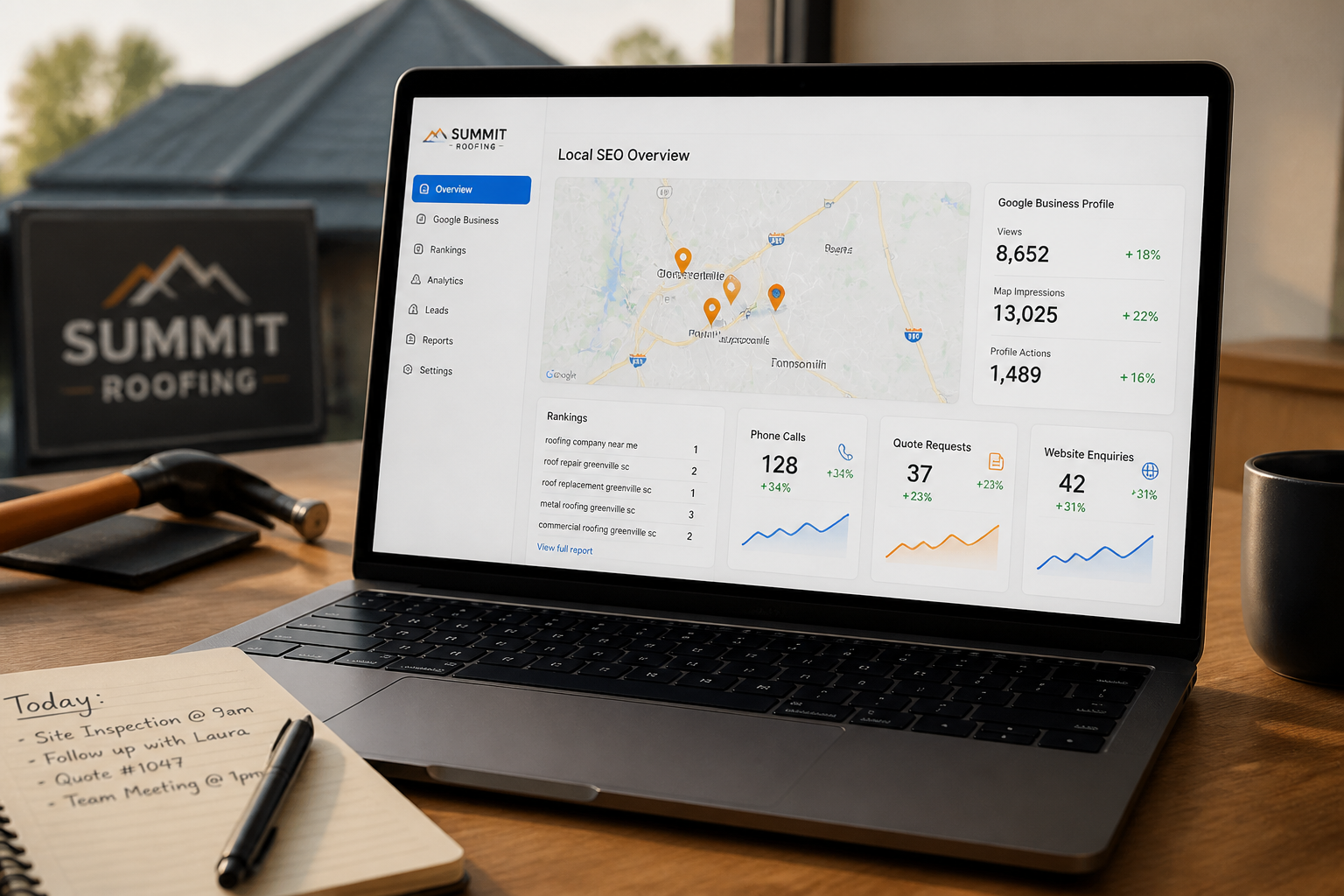
Track organic clicks, impressions, CTR, average position, keyword rankings, Google Maps rankings, Google Business Profile views, GBP calls, website visits from GBP, direction requests, form submissions, quote requests, phone calls, booked inspections, organic traffic by service page, organic traffic by location page, backlink growth and review growth.
Lead quality matters
Not every lead is equal. Track which leads are roof repair, roof replacement, emergency repair, commercial roofing, small repair, inspection only, outside service area or low-quality enquiry. This helps refine SEO strategy.
Use Google Search Console and GA4
Google Search Console can show which roofing queries get impressions, which pages are visible, which keywords have low CTR, which pages are close to page one, which locations are gaining impressions and which service pages need improvement.
GA4 can help track form submissions, click-to-call events, quote requests, thank-you page visits, traffic by channel and landing page performance. Without tracking, it is hard to prove SEO value — for real examples, see our /case-studies.
90-Day Roofing SEO Action Plan
If your roofing company wants to improve local leads, use a structured plan.
Days 1–30: audit and foundation fixes
Review Google Search Console, audit Google Business Profile, check local rankings, review service pages, review location pages, check technical SEO, check website speed, review mobile usability, audit reviews, check citations, review competitor websites and set up call and form tracking. Goal: find what is blocking local visibility and lead generation.
Days 31–60: optimize key pages and local signals
Optimize main roofing service pages, improve title tags and meta descriptions, add missing FAQs, add internal links, improve Google Business Profile services, add real project photos, improve review response strategy, clean up citations, add LocalBusiness schema, improve quote CTAs and create or improve priority location pages. Goal: make your website and Google profile more relevant, trustworthy and conversion-focused.
Days 61–90: build authority and expand content
Publish helpful roofing blog content, build local backlinks, add project examples or case studies, improve pages with impressions but low clicks, create supporting service/location content, monitor rankings and leads, review call quality, adjust strategy based on data and plan next 90 days. Goal: strengthen visibility and turn more local searches into roofing enquiries.
Roofing SEO Checklist
Use this checklist to review your roofing SEO across Google Business Profile, website, on-page SEO, local SEO and tracking.
Google Business Profile
- Business name is accurate
- Category is correct
- Services are added
- Service areas are updated
- Phone number is correct
- Website link works
- Hours are accurate
- Photos are real and recent
- Reviews are monitored
- Review responses are professional
- Q&A section is useful
Roofing website and on-page SEO
- Main roofing services have dedicated pages
- Location pages are useful and unique
- Phone number is visible
- Quote CTA is clear
- Website is mobile-friendly
- Pages load quickly
- Reviews are visible on the site
- Project photos are included
- Contact forms work
- Thank-you page tracking is set up
- Titles include service and location where relevant
- Meta descriptions are written for clicks
- H1 tags are clear
- Headings are structured properly
- Content matches search intent
- FAQs are included
- Internal links connect related pages
- Images have alt text
- Schema is added where relevant
Local SEO and tracking
- Citations are consistent
- NAP details match across platforms
- Local directories are updated
- Reviews are growing naturally
- Local backlinks are being built
- Google Maps rankings are tracked
- Service-area pages are useful
- Local content supports target locations
- Google Search Console is connected
- GA4 is installed
- Calls are tracked
- Forms are tracked
- Quote requests are tracked
- GBP actions are monitored
- Leads are reviewed by quality
- Monthly reporting shows next actions
Common Roofing SEO Mistakes
The most common roofing SEO mistakes are simple, but they cost real leads every month.
Structural and profile mistakes
Having only one generic roofing services page usually cannot rank for every roofing service — create dedicated pages for important services. Ignoring Google Business Profile is a major miss because Google Maps can drive high-intent calls; your profile should be complete, active and trustworthy. Using stock photos only reduces trust — real project photos build more confidence than generic images. Creating thin city pages where only the city name changes is weak; each location page should be genuinely useful.
Tracking, trust and expectation mistakes
Not tracking calls means SEO performance is often underestimated. Ignoring reviews reduces conversions. A slow mobile website can lose urgent leads. No internal linking weakens important service and location pages. Targeting only broad keywords like "roofing" is too competitive — target service and location-specific searches. Finally, expecting instant results is a mistake: SEO takes time, and roofing companies need consistent improvements across content, local SEO, reviews, technical SEO and authority. For a related read, see /blog/local-seo-for-small-business.
Final Thoughts
SEO helps roofing companies win more local leads by making the business easier to find, easier to trust and easier to contact. When homeowners search for roof repair, emergency roofing, roof replacement, gutter repair or roofing companies near them, your business needs to appear where they are looking — Google Search, Google Maps, your Google Business Profile, your service pages, your location pages, reviews, project photos, local citations, backlinks, helpful content and clear quote request paths.
Roofing SEO is not just about rankings — it is about creating a local lead generation system. A strong strategy helps your company show up for high-intent local searches, build trust before the first call, generate more quote requests, improve Google Maps visibility, support emergency and service-specific searches, reduce dependence on paid ads over time and track which searches turn into real roofing leads.
The roofing companies that win online are not always the biggest. They are often the ones that are easiest to find, easiest to trust and easiest to contact when the customer needs help. If you want a dedicated plan for your business, our /industries/roofing-seo and /industries/home-services-seo pages are a good next step, along with /contact to request a free roofing SEO audit.