
Why SEO Work Does Not Always Lead To Rankings
SEO is not a checklist where every completed task automatically creates ranking growth.
You can update meta titles, add keywords and publish blogs, but if the core problems are still present, Google may not reward the site.
For example, your website may still struggle if:
- The pages are indexed but not useful enough
- The content does not answer the search intent properly
- The website has poor internal linking
- Your competitors have stronger authority
- Your backlinks are low quality
- Your service pages are too generic
- Your website is slow or technically messy
- Your titles are not attractive enough to earn clicks
- Google has not had enough time to reassess the site
The real problem
This is why many businesses feel like they have done SEO but still do not see meaningful growth. The problem is usually not that SEO does not work — the problem is that the SEO work may not have gone deep enough or may not have focused on the most important ranking barriers.
You May Be Targeting The Wrong Keywords
One of the biggest reasons websites do not rank after SEO work is poor keyword targeting.
Many businesses target keywords that are either too broad, too competitive or not aligned with what their ideal customers actually search. A new SEO agency, for example, may try to rank for "SEO agency", "SEO services" or "digital marketing agency" — highly competitive terms where a newer website may get impressions but not page-one rankings.
A better strategy is to target more specific keywords first, such as:
- SEO services for small businesses
- Local SEO services for cleaning companies
- Shopify SEO consultant
- SEO audit for service business website
- Google Search Console impressions but no clicks
- SEO for real estate agents
- SEO for travel brands
Signs you are targeting the wrong keywords
- Your pages get impressions but no clicks
- Average position is very low
- Your competitors are large national brands
- Your content is too general
- Your pages do not match buyer intent
- You rank for informational keywords but get no leads
- You have traffic but no conversions
Core commercial keywords
These are your main service keywords — examples include SEO services, local SEO services, technical SEO agency and eCommerce SEO services.
Industry-specific keywords
These are easier to target and more specific — SEO for cleaning businesses, SEO for real estate agents, SEO for travel companies and SEO for SaaS companies.
Problem-based keywords
These attract people who already feel pain — why is my website not ranking on Google, why are my impressions increasing but clicks are low, how long does SEO take and why is my website getting traffic but no leads. The best SEO strategy usually combines all three levels.
Your Content May Not Match Search Intent
Google does not rank pages only because they contain keywords. Google tries to rank pages that satisfy the reason behind the search — the search intent.
If someone searches "best SEO agency for small business", they probably want comparison, trust signals, pricing guidance, case studies and reasons to choose an agency. If your page only says "we provide SEO services", it may not be enough.
- Writing generic content instead of specific answers
- Adding keywords without answering the real question
- Creating service pages that all sound the same
- Publishing blogs that do not solve a specific problem
- Writing for Google instead of real customers
- Not explaining pricing, process, deliverables or outcomes
- Missing FAQs, proof, reviews or examples
Example: SEO for cleaning businesses
A page targeting "SEO for cleaning businesses" should not only say "we help cleaning businesses rank higher". It should explain cleaning service SEO, Google Business Profile optimization, local rankings, quote request tracking, service pages, location pages, review strategy, cleaning customer search behaviour, common cleaning SEO mistakes and how SEO turns into calls and quote requests. That is how content becomes useful and specific.
How to fix search intent issues
- What exactly is the searcher trying to do?
- Are they researching, comparing or ready to buy?
- What questions do they need answered before contacting us?
- What would make this page more helpful than competitors?
- Does the page include proof, process, FAQs and clear CTAs?
- Does the page naturally guide users to the next step?
Your Service Pages May Be Too Thin
Many websites focus too much on blog content and ignore service pages. But for lead generation, your service pages are usually the most important pages.
A thin service page typically includes a short intro, a few bullet points, a contact button, generic claims — and nothing else. That is usually not enough in competitive search results.
What a strong service page should include
- Clear H1 and strong opening paragraph
- Specific service explanation and who it is for
- Problems you solve and how
- Your process and deliverables
- Benefits, proof points and reviews
- FAQs and related services
- Clear CTA and schema markup
- Internal links to related content
Why thin pages struggle
Thin pages struggle because Google has less context. Search engines need to understand what the page is about, who it helps, what services are included, how it is different from other pages and whether it is useful enough to rank. If your competitors have detailed, helpful and well-structured pages, a thin page will usually fall behind.
Google May Not Be Indexing The Right Pages
Sometimes the issue is not ranking — it is indexing. If Google has not indexed your important pages, they cannot rank. This can happen even after SEO work.
- Pages discovered but not indexed
- Crawled but currently not indexed pages
- Duplicate pages and canonical tag issues
- Accidental noindex tags
- Pages blocked in robots.txt
- Poor internal linking
- Sitemap issues
- Thin content and too many low-value pages
- JavaScript rendering problems
What to check in Google Search Console
- Pages report and indexing status
- Sitemap submission
- URL Inspection tool for priority pages
- Canonical selected by Google
- Crawled but not indexed pages
- Discovered but not indexed pages
How to improve indexing
- Add important pages to the XML sitemap
- Internally link important pages from strong pages
- Remove noindex tags from pages that should rank
- Improve thin content and fix duplicates
- Avoid creating too many low-value pages
- Use URL Inspection for priority pages
- Keep site structure simple and crawlable
Technical SEO Issues May Be Holding You Back
Technical SEO is not always visible to business owners, but it can strongly affect rankings. A website may look good but still have technical issues that make it harder for Google to crawl, render or understand the content.
- Slow page speed and poor Core Web Vitals
- Poor mobile usability
- Broken internal links and redirect chains
- Duplicate title tags and missing or multiple H1s
- Poor canonical tags and sitemap errors
- Robots.txt blocks and JavaScript rendering problems
- Broken schema and thin indexed pages
- 404 errors, unoptimized images and poor URL structure
Critical issues to fix first
- Indexing errors and noindex mistakes
- Robots.txt blocks
- Broken pages and canonical problems
- Important pages not found by Google
High-priority issues
- Slow mobile speed and poor Core Web Vitals
- Duplicate content
- Broken internal links
- Missing schema and weak internal linking
Medium-priority issues
- Image optimization
- Metadata duplication
- Minor heading issues
- Redirect cleanup and sitemap improvements
Your Website May Not Have Enough Authority
Content quality matters, but authority still matters too. If your competitors have stronger backlinks, brand recognition, reviews, case studies and trusted mentions, they may outrank you even if your content is good.
Authority is especially important in competitive industries such as SEO, legal, healthcare, finance, SaaS, real estate, eCommerce, home services, education and travel.
Signs your website lacks authority
- Your content is good but rankings stay low
- Competitors have many more referring domains
- Your website is new
- Your brand has few mentions online
- You have few or no reviews
- Your case studies are limited
- Your site has weak backlinks
- Your content is not cited or referenced elsewhere
Authority signals to build
- Quality backlinks and digital PR
- Guest features and case studies
- Client reviews and directory listings
- Google Business Profile and social profiles
- Founder profiles and industry mentions
- Podcast or interview features
- Partner links and local citations
- Original data and insights
Your Backlinks May Be Weak Or Irrelevant
Not all backlinks help SEO. Some backlinks are low quality, irrelevant or ignored by Google. If your SEO work included link building but rankings did not improve, the links may not be strong enough.
Weak link building looks like this
- Random directory links
- Low-quality profile links
- Spammy blog comments
- Irrelevant guest posts
- Links from websites with no real traffic
- Exact-match anchor text repeated too often
- Links from unrelated niches
- Low-quality link farms
- Paid links with no editorial value
Better link building looks like this
- Relevant industry websites
- Local business websites
- Real guest features and digital PR mentions
- Resource pages and case study references
- Partner and supplier websites
- Niche directories and podcast pages
- News mentions
- Useful content people naturally cite
Questions to ask about your backlink profile
- Are the links relevant?
- Do the linking websites look real?
- Are they indexed and do they have traffic?
- Are they connected to your industry?
- Are anchor texts natural?
- Are links pointing to important pages?
- Are competitors earning better links?
Internal Linking May Be Missing
Internal links are one of the most underrated SEO improvements. They help Google understand which pages are important and how your website topics connect. If your website has many pages but poor internal linking, Google may not know which pages deserve priority.
- Important pages buried too deep in the site
- Blog posts not linking to service pages
- Case studies not linking to relevant services
- Industry pages not linked from the homepage
- No related services section
- No contextual links inside content
- Too many orphan pages
- Weak footer links and no topic clusters
Example
A blog titled "Why Your Website Is Not Ranking On Google Even After SEO Work" should internally link to the SEO audit service page, technical SEO service page, on-page SEO service page, link building service page, content marketing page, case studies page and contact page. This helps users and search engines move through the site naturally.
Internal linking fixes
- Related service and related blog links
- Case study and CTA links
- Breadcrumbs and "recommended reading" blocks
- Links from old blogs to new pages
- Links from the homepage to priority pages
Your Titles May Not Be Getting Clicks
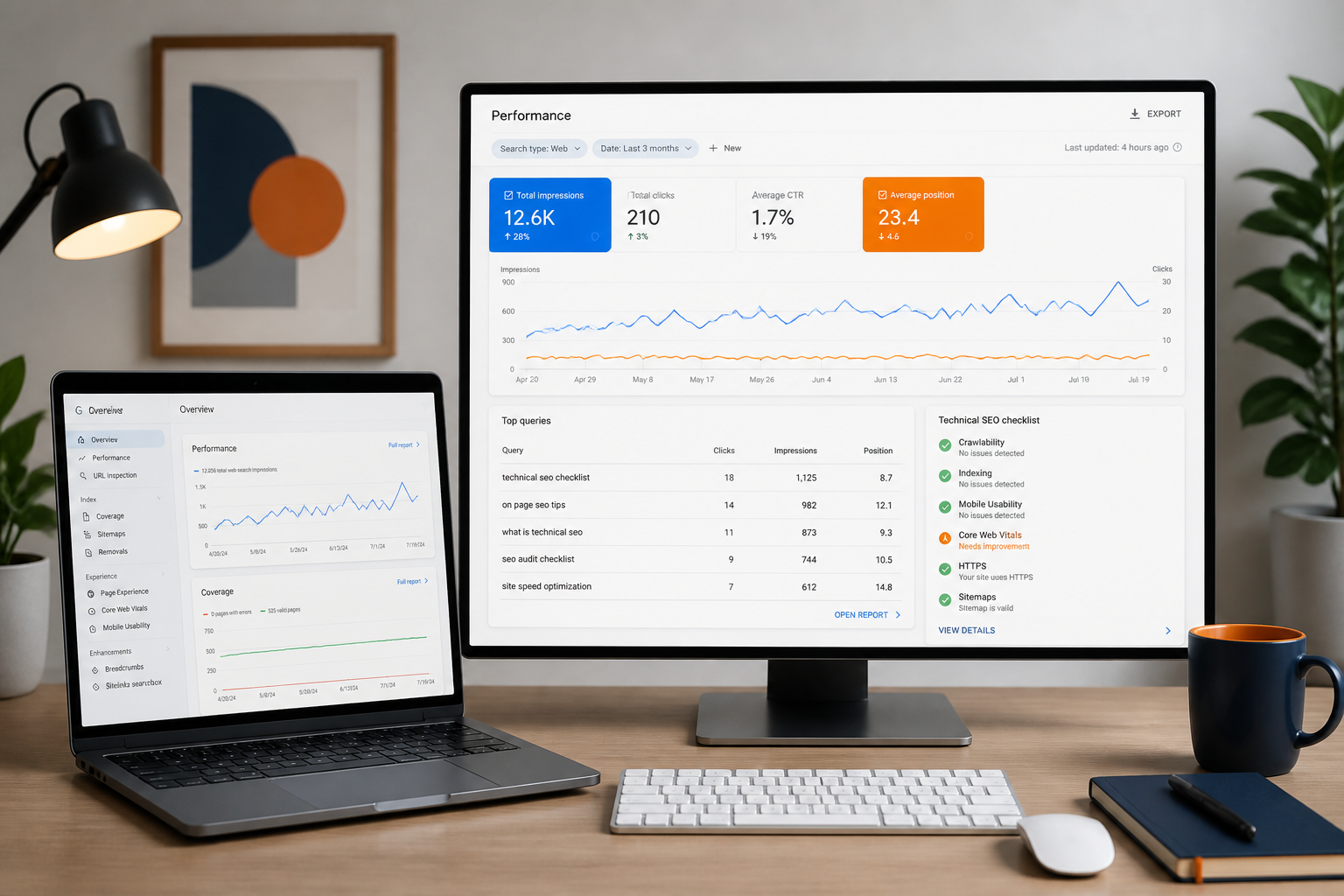
Sometimes your website is ranking, but users are not clicking. In Google Search Console this shows up as impressions increasing, clicks staying low, very low CTR and average position improving only slowly.
This does not always mean your SEO is failing. It may mean your title tags and meta descriptions are not compelling enough — or your rankings are still too low.
- Your ranking position is too low
- Your title is too generic
- Your meta description is weak
- Competitors have stronger titles
- Your page does not match search intent
- Your brand is not trusted yet
- SERP features are taking clicks
- Google rewrites your title
- Your page appears for irrelevant queries
How to improve CTR
- Include the main keyword
- Add a clear benefit
- Make the title specific
- Avoid clickbait and match search intent
- Use numbers where useful
- Mention audience or industry
- Write a clear meta description
- Test changes every few weeks
| Weak Title | Stronger Title |
|---|---|
| SEO Services | SEO Services That Help Businesses Grow Rankings, Traffic & Leads |
| Technical SEO Audit | Technical SEO Audit Checklist: Find & Fix Ranking Issues |
| Cleaning SEO | SEO For Cleaning Businesses | Get More Local Cleaning Leads |
Your Competitors May Be Doing More Than You Think
Sometimes your SEO is improving, but competitors are improving faster. This is why competitor analysis matters. You are not ranking in isolation — you are competing against websites that may have more backlinks, older domains, stronger topical authority, better service pages, more case studies, better reviews, stronger local presence, more helpful blogs, better internal linking, faster websites and more brand searches.
What to compare
- Content depth and page structure
- Title tags and service pages
- Blog strategy and backlink profile
- Internal links and case studies
- Reviews and Google Business Profile
- Schema and website speed
- Conversion layout
The real SEO benchmark
Do not only ask "did we do SEO?". Ask "did we do enough to become better than the pages currently ranking above us?". That is the real SEO benchmark.
Your SEO May Need More Time
SEO takes time, especially if the website is new, has low authority or is in a competitive niche. Google needs time to crawl the changes, understand updated pages, reprocess internal links, reassess content quality, evaluate backlinks, compare your pages with competitors, test rankings, measure user signals and build trust in your domain.
First 30 days
Technical fixes, on-page improvements, indexing checks, keyword mapping, content planning and tracking setup.
30–60 days
More pages indexed, impressions begin increasing, long-tail keywords start appearing and some pages move from invisible to low positions.
60–90 days
More ranking movement, early clicks may increase, Google tests pages for more queries and internal linking and content improvements start to compound.
3–6 months
Stronger keyword movement, more stable rankings, better traffic quality and more lead opportunities if conversion paths are strong.
6–12 months
Authority growth compounds, competitive keywords may improve, content clusters mature and SEO becomes more predictable.
How To Diagnose The Real Problem In Google Search Console
Google Search Console is one of the best tools for understanding why your website is not ranking. Do not only look at total clicks — look deeper.
Step 1: Check queries
Go to Performance → Search Results → Queries and look for high impressions with low clicks, keywords ranking between positions 11–30 and 31–60, queries with low CTR, irrelevant queries and branded vs non-branded keywords.
Step 2: Check pages
Go to Performance → Pages and identify which pages are getting impressions. Ask: are these the right pages? Are service pages getting visibility? Are blogs getting impressions? Are important pages missing? Are pages ranking for the right queries?
Step 3: Check average position
Use average position carefully. A site-wide average can look bad because one page may appear for many low-ranking queries. Check average position by page and by query instead.
Step 4: Find quick wins
Look for keywords in positions 11–30 — often the best opportunities. For these pages, improve content depth, title tag, meta description, internal links, FAQ section, schema, supporting content and backlinks.
Step 5: Check indexing
- Not indexed pages
- Crawled but not indexed
- Discovered but not indexed
- Duplicate without user-selected canonical
- Alternate page with proper canonical
- Soft 404
- Blocked by robots.txt
- Excluded by noindex
90-Day Action Plan To Improve Rankings
If your website is not ranking even after SEO work, do not panic. Use a structured 90-day plan.
Days 1–30: Diagnose & fix foundations
- Review Google Search Console queries and pages
- Identify pages with impressions but low clicks
- Check indexing issues and crawl the website
- Fix technical SEO errors
- Review sitemap and robots.txt
- Check title tags and meta descriptions
- Identify thin pages and review top competitors
- Improve internal linking to priority pages
- Check GA4 and conversion tracking
Days 31–60: Improve content & search intent
- Rewrite weak service pages
- Add missing FAQs and improve H1/H2 structure
- Add stronger CTAs, proof points and reviews
- Create supporting blogs and add internal links
- Improve title tags for CTR
- Add schema markup
- Refresh pages with impressions but weak rankings
Days 61–90: Build authority & measure progress
- Build relevant backlinks
- Add case studies and client reviews
- Improve About page trust signals
- Strengthen author bios
- Add business profiles and citations
- Promote best content and monitor ranking movement
- Review pages in positions 11–30
- Track leads, calls and form submissions
SEO Recovery Checklist
Use this checklist to review why your website is not ranking. If most items are missing, that is your prioritization list for the next 90 days.
Technical SEO
- Important pages are indexed
- No accidental noindex tags
- Sitemap submitted in Google Search Console
- Robots.txt is not blocking important pages
- No major crawl errors
- Website loads fast on mobile
- Core Web Vitals are acceptable
- Broken links and redirect chains are fixed
- Canonicals are correct
On-page SEO
- Each page has one clear H1
- Title tags include keyword and benefit
- Meta descriptions are written for clicks
- Headings are structured properly
- Content matches search intent
- FAQs are included where useful
- Images have descriptive alt text
- URLs are clean and readable
- Schema is added where relevant
Content quality
- Service pages are detailed
- Content is original
- Pages answer real customer questions
- Content is not duplicated across pages
- Blogs support service pages
- Case studies and proof are visible
- Pages include clear next steps
Authority
- Website has relevant backlinks
- Brand is mentioned on trusted websites
- Google Business Profile is optimized
- Reviews are visible
- Social profiles are consistent
- Case studies are published
- Author and team information is clear
Internal linking
- Homepage links to priority pages
- Blogs link to service pages
- Service pages link to related services
- Case studies link to relevant services
- No important page is orphaned
- Anchor text is descriptive
Tracking
- Google Search Console is connected
- GA4 is installed
- Form submissions are tracked
- Calls are tracked where possible
- Thank-you pages are working
- Organic leads can be measured
- Rankings are monitored by keyword and page
Final Thoughts
If your website is not ranking on Google even after SEO work, it does not always mean SEO has failed. It usually means one of three things: the right work has not been done yet, the work needs more time to compound, or competitors are still stronger in content, authority or trust.
Good SEO is not about doing random tasks every month. It is about finding the real ranking blockers and fixing them in the right order. Start with Google Search Console. Find pages with impressions. Check which keywords Google is testing. Improve the pages that are close to ranking. Strengthen internal links. Fix technical issues. Build trust with reviews, case studies and backlinks.
And most importantly, measure SEO by business outcomes — not just rankings. The real goal is not only to rank. The real goal is to turn search visibility into traffic, enquiries, leads and revenue.