

What Is AI SEO?
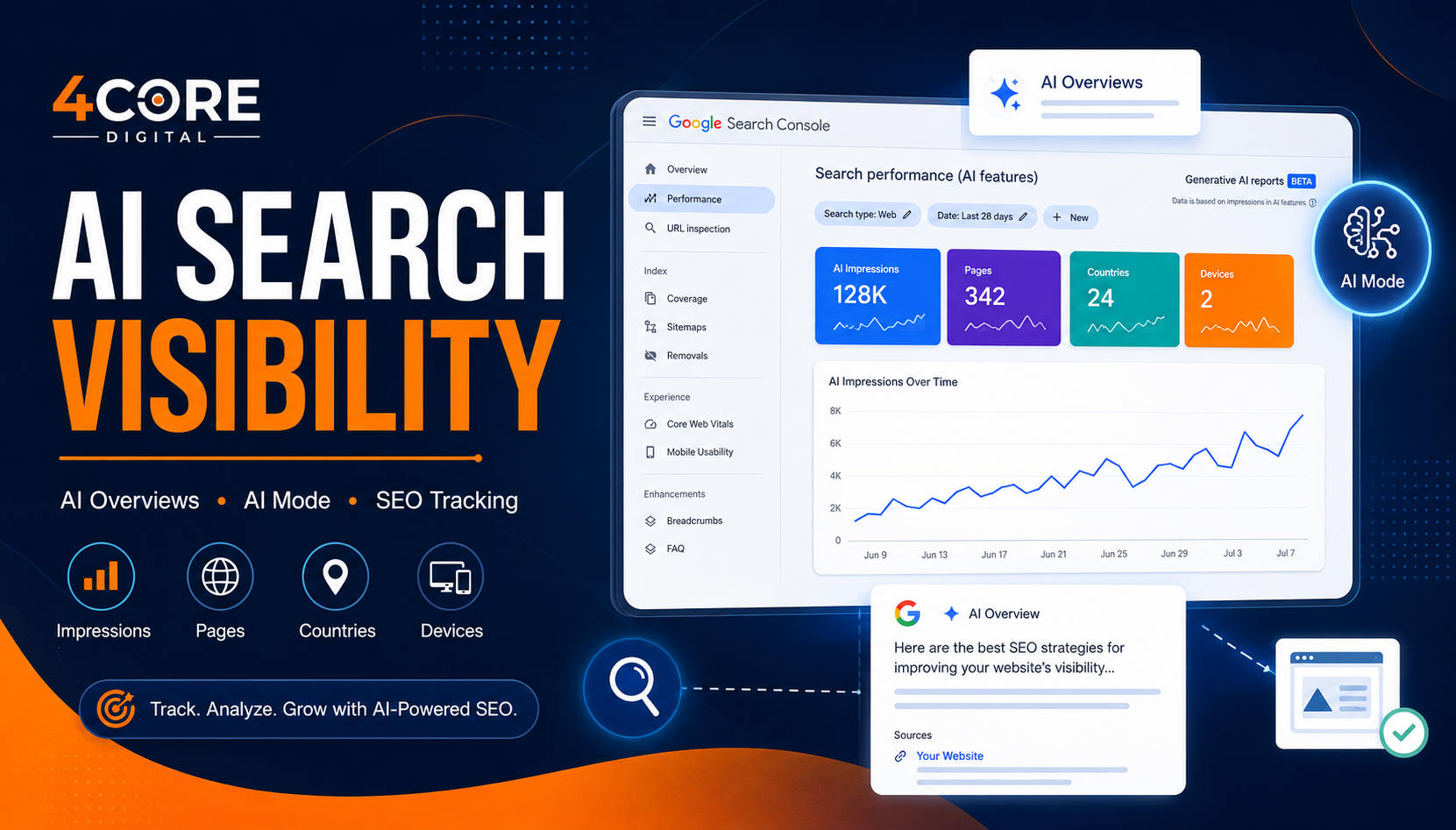
AI SEO is the practice of optimizing your website, content and brand signals so that AI platforms — including ChatGPT, Gemini, Perplexity, Claude, Microsoft Copilot and Google AI Overviews — can understand your business, trust your information and recommend you inside AI-generated answers.
Instead of only competing for the top blue link, AI SEO asks a different question: when a buyer asks an AI tool for a recommendation, a comparison or a how-to, does the AI describe your brand correctly, link to your pages and treat you as a credible source?
AI SEO does not replace traditional SEO. It builds on the same foundations — crawlability, useful content, structure and authority — and then layers on entity clarity, answer-friendly formatting, schema and brand trust so AI systems can extract and cite your content with confidence.
- AI SEO means optimizing for AI-generated answers and recommendations.
- It applies to ChatGPT, Gemini, Perplexity, Claude, Copilot and Google AI Overviews.
- The goal is to make your brand easier to understand, verify and cite.
- It builds on traditional SEO — not against it.
How Is AI SEO Different From Traditional SEO?
Traditional SEO is built around ranking individual URLs in a list of results. AI SEO is built around being included, summarized and recommended inside a generated answer. The difference shows up across goals, signals, content style and how you measure success.
| Area | Traditional SEO | AI SEO |
|---|---|---|
| Goal | Rank URLs in the SERP | Get cited inside AI-generated answers |
| Platform | Google, Bing | ChatGPT, Gemini, Perplexity, Copilot, Google AI Overviews |
| Visibility format | 10 blue links + features | Summarized answers with cited sources |
| Content style | Keyword-led, long-form | Answer-first, entity-rich, well-structured |
| Authority signals | Links, content quality, E-E-A-T | Links, brand mentions, entity consistency, citations |
| Measurement | Rankings, clicks, sessions | AI referrals, citation frequency, brand mentions |
| User behaviour | Browse and compare sources | Read the answer, click only to verify or buy |
AI SEO vs AEO vs GEO
These three terms are often used interchangeably, but they describe slightly different things. Knowing the difference helps you brief content, audits and strategy more clearly.
AI SEO
AI SEO is the broadest term. It covers everything you do to be visible across AI search and AI tools — from technical SEO and structured data to entity clarity, brand mentions and answer-friendly content.
AEO — Answer Engine Optimization
AEO focuses on optimizing for direct answers — featured snippets, People Also Ask, voice answers and AI quick-answer boxes. Think of it as the answer-extraction layer of AI SEO.
GEO — Generative Engine Optimization
GEO focuses specifically on being cited inside generative outputs from tools like ChatGPT, Gemini and Perplexity. It overlaps heavily with AI SEO but emphasizes the citation and recommendation behavior of large language models.
Why AI SEO Matters In 2026
Buyer behaviour has shifted. People now ask AI tools for shortlists, comparisons and recommendations before they ever visit a website. By the time they reach your page, the AI has already framed the conversation — sometimes including your brand, sometimes excluding it.
- Buyers ask AI tools for recommendations before searching Google.
- AI tools summarize options, pros and cons before users visit any website.
- Google AI Overviews can answer questions directly inside search results.
- Brands with unclear content and weak trust signals are quietly skipped or misrepresented.
- Being cited in AI answers builds authority that compounds across both AI and traditional search.
How AI Search Engines Choose Sources
AI search engines do not pick sources at random. They combine traditional ranking strength with semantic understanding, entity recognition and trust signals to decide which pages are safe to summarize and cite.
- Content clarity — short, direct answers near the top of each section.
- Topic depth — multiple supporting pages around the same theme.
- Entity recognition — consistent brand, service, location and product names.
- Brand consistency — the same description of your business across the web.
- Structured data — Article, FAQ, Product, Organization and Breadcrumb schema.
- Trusted mentions — references from reputable directories, publications and review sites.
- Freshness — recently published or updated information.
- Original insight — unique data, examples, frameworks and case studies.
- Authority — backlinks and citations from credible sources.
- Internal linking — clear relationships between pillar pages and supporting articles.
- User-focused answers — content written for buyers, not for keyword volume.
What Makes Content AI-Friendly?
AI-friendly content is content that a language model can read, extract and quote without guessing. The pattern is consistent across every AI platform: short direct answers, clean structure, real proof and trustworthy signals around the author and brand.
- Clear H1/H2/H3 structure that mirrors how buyers ask questions.
- Short answer paragraphs (40–80 words) at the top of each section.
- FAQ blocks that answer the most common follow-up questions.
- Schema markup — Article, FAQPage, Product, Organization, Breadcrumb.
- Concrete examples and step-by-step instructions.
- Comparison tables for 'X vs Y' and 'best X for Y' queries.
- Internal links to related services, case studies and supporting content.
- Author name, role and bio on every important article.
- Visible trust signals — reviews, case studies, certifications, real photos.
- Clear published and updated dates.
How To Optimize Your Website For AI SEO
AI SEO is a system, not a one-off task. The steps below stack: each one makes the next more effective and gives AI platforms more reasons to trust and reference your brand.
1. Strengthen your existing SEO foundation
Fix crawl errors, broken links, duplicate content and slow pages first. AI platforms rely heavily on the same crawl and rendering pipeline as traditional search.
2. Build entity clarity
Use the same brand name, service names, locations and descriptions across your website, Google Business Profile, social profiles and directory listings. Inconsistent naming confuses AI models.
3. Create answer-friendly content
Lead every section with a direct answer, then expand with supporting detail, examples and proof. Avoid burying the answer in long unstructured paragraphs.
4. Add schema markup
Implement Article, FAQPage, Product, Organization, LocalBusiness and Breadcrumb schema. Validate everything in Google's Rich Results test.
5. Build topic clusters
Group related pages into clusters: one pillar page plus several supporting articles, all interlinked. This signals depth and helps AI tools associate your brand with the topic.
6. Earn brand mentions
Get your brand mentioned on relevant directories, publications, podcasts and review sites — with or without a link. Mentions are a key signal for AI trust.
7. Track AI visibility
Monitor AI referral traffic in GA4, sample prompts in ChatGPT, Gemini and Perplexity, and track which pages get cited most often. Use the data to prioritize updates.
What AI SEO Means For Service Businesses
For service businesses, AI SEO is how you stay on the shortlist when buyers ask AI tools things like 'best SEO agency for small business' or 'top dentist near me'. The brands that win are the ones with clear service pages, strong local signals and visible proof.
- Service pages — one clear page per service, with scope, deliverables and outcomes.
- Location pages — dedicated pages for each city or region you serve.
- FAQs — answer the real questions buyers ask before, during and after the buying decision.
- Reviews — visible, recent, on Google and on your website.
- Trust signals — certifications, partner badges, team bios and real photos.
- Case studies — specific results with context, not vague claims.
Examples by industry
- SEO agency — service pages by channel, case studies by industry, founder authority.
- Dentist — service pages by treatment, location pages by suburb, real patient reviews.
- Plumber — service pages by job type, emergency availability, GBP optimization.
- Consultant — clear methodology, named case studies, strong personal brand.
- SaaS company — use-case pages, integration pages, comparison pages, documentation.
What AI SEO Means For eCommerce Brands
For eCommerce brands, AI SEO decides whether your products appear in AI-generated shortlists, buying guides and comparisons. AI tools need rich, structured product information and credible third-party signals to recommend a product with confidence.
- Product details — clear titles, specs, materials, sizing and use cases.
- Category pages — unique copy, intent-aligned keywords, curated product sets.
- Product schema — Product, Offer, AggregateRating and Review markup on every PDP.
- Reviews — visible UGC with star ratings and verified buyer signals.
- Buying guides — 'best X for Y' and 'how to choose X' content with internal links.
- Comparison pages — your product vs alternatives, with honest pros and cons.
- FAQs — shipping, returns, sizing, materials and care.
- Brand mentions — coverage on review sites, gift guides and niche publications.
Common AI SEO Mistakes
Most AI SEO mistakes are not new — they are old SEO mistakes amplified by AI's preference for clear, trustworthy sources. Avoiding them is often more valuable than chasing the latest tactic.
- Publishing generic AI-written content with no original insight or proof.
- Ignoring traditional SEO foundations like crawlability, internal links and content quality.
- Skipping schema markup on important pages.
- Lacking topical depth — one shallow page per topic instead of a real cluster.
- Hiding author information or using anonymous bylines.
- Letting old content go stale and never updating it.
- Not earning any brand mentions outside your own website.
- Not tracking AI referral traffic in GA4.
- Targeting keywords without considering buyer intent.
- Using thin FAQ sections that answer obvious questions instead of real ones.
How To Measure AI SEO Performance
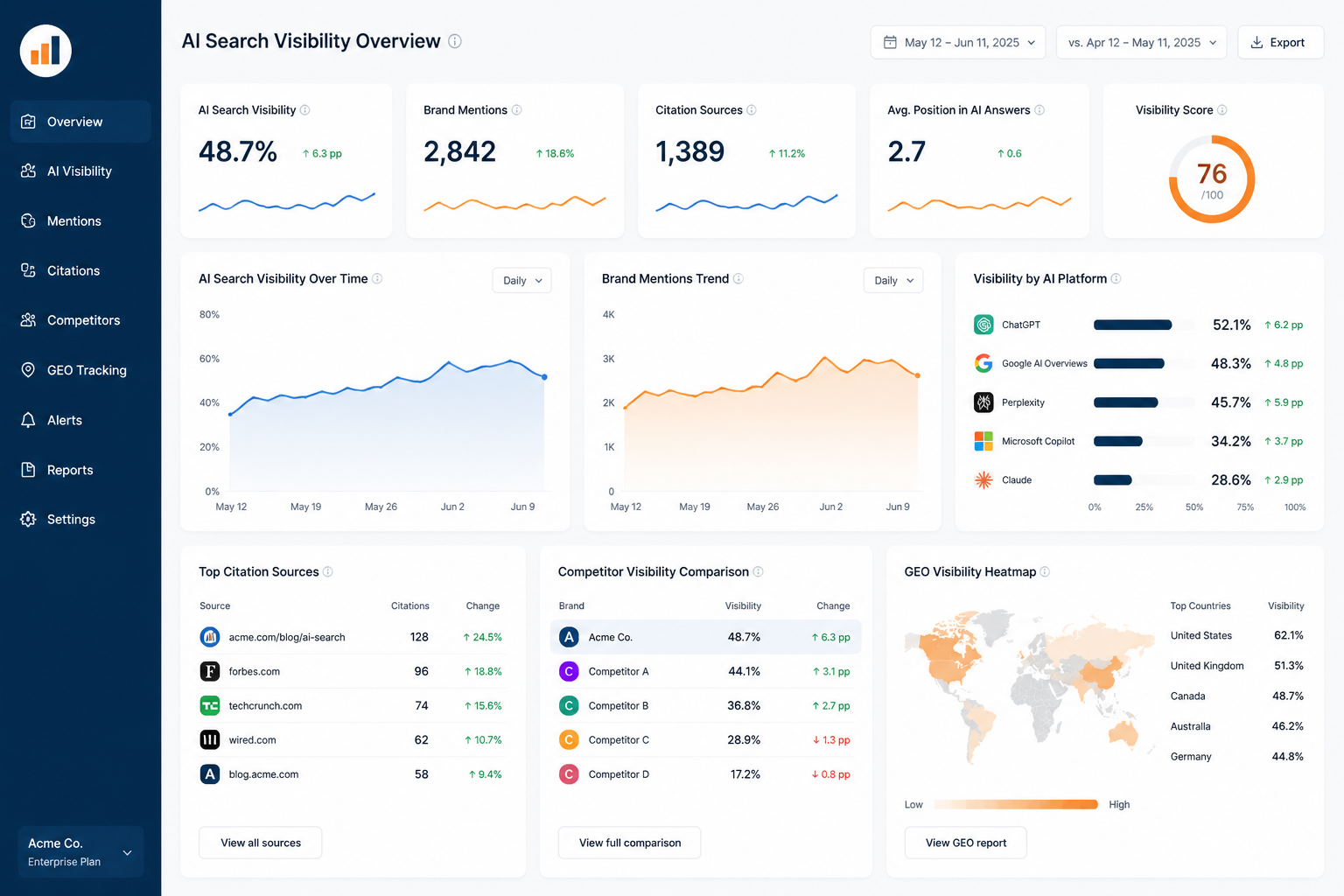
AI SEO needs its own measurement layer on top of traditional SEO. The metrics below help you see whether AI platforms are noticing, citing and recommending your brand — not just whether you rank in Google.
| Metric | What It Shows | Why It Matters |
|---|---|---|
| AI referral traffic | Visits from ChatGPT, Gemini, Perplexity and Copilot | Direct evidence AI tools are sending users to your site |
| Brand mentions in AI answers | How often your brand is named in AI responses | Indicates AI tools recognize and trust your brand |
| Citation frequency | How often your URLs appear as sources in AI answers | Shows which pages AI platforms treat as authoritative |
| Organic clicks | Clicks from traditional Google search | Foundation that feeds AI visibility |
| Search impressions | How often your pages appear in search results | Tracks growing topical coverage |
| Assisted conversions | Leads and sales influenced by AI or organic touchpoints | Connects AI visibility to revenue |
| Topical coverage | Number of supporting pages per topic cluster | Predicts long-term AI authority on a subject |
90-Day AI SEO Action Plan
A focused 90-day plan is enough to move the needle on AI visibility for most websites. The plan below splits the work into three 30-day phases so the team always knows what to focus on next.
Days 1–30: Audit & Foundation
- Technical SEO check — crawl, index, speed, mobile, internal links.
- Content audit — identify thin, outdated and duplicated pages.
- Entity mapping — brand, services, locations, products, people.
- Schema review — fix and extend structured data coverage.
- Search Console review — top queries, pages, opportunities.
- AI visibility baseline — sample prompts in ChatGPT, Gemini and Perplexity.
Days 31–60: Content & Structure
- Rewrite priority service, location and product pages.
- Add real FAQs to every important page.
- Create comparison and 'best of' content for buyer-intent queries.
- Improve internal links between pillars and supporting content.
- Publish supporting blog content that strengthens topic clusters.
- Add or upgrade schema on all newly updated pages.
Days 61–90: Authority & Measurement
- Build brand mentions through PR, directories and partnerships.
- Add new case studies with real context and outcomes.
- Improve author profiles, bios and About content.
- Track AI referral traffic and conversions in GA4.
- Re-test priority prompts in AI tools to verify citation lift.
- Refresh underperforming pages based on the first 60 days of data.
AI SEO Checklist
Use this checklist as a quick health check for AI SEO across your website. If most items are missing, that is the prioritization list for the next 90 days.
- Website is crawlable and free of major technical errors.
- Important pages are indexed in Google Search Console.
- Brand information is consistent across website, GBP and directories.
- Services are clearly explained on dedicated pages.
- Key pages include real, useful FAQ sections.
- Schema markup is implemented on articles, services, products and FAQs.
- Content is structured with descriptive H2 and H3 headings.
- Blog content supports service and product pages through internal links.
- Case studies are visible and link to relevant service pages.
- Reviews are visible on the website and on Google Business Profile.
- Internal links connect related pages across the site.
- Author information is clear on every article.
- AI referral traffic is monitored in GA4.
Final Thoughts
AI SEO is not about tricking AI tools. It is about making your business easier to understand, verify and recommend. The brands that win will be the ones with clear content, strong entities, useful answers, real proof and a website structure that supports both search engines and AI platforms.
If you treat AI SEO as an extension of doing the fundamentals well — and stay patient through the first 90 days — the compounding effect across Google, ChatGPT, Gemini, Perplexity and AI Overviews can be significant.