
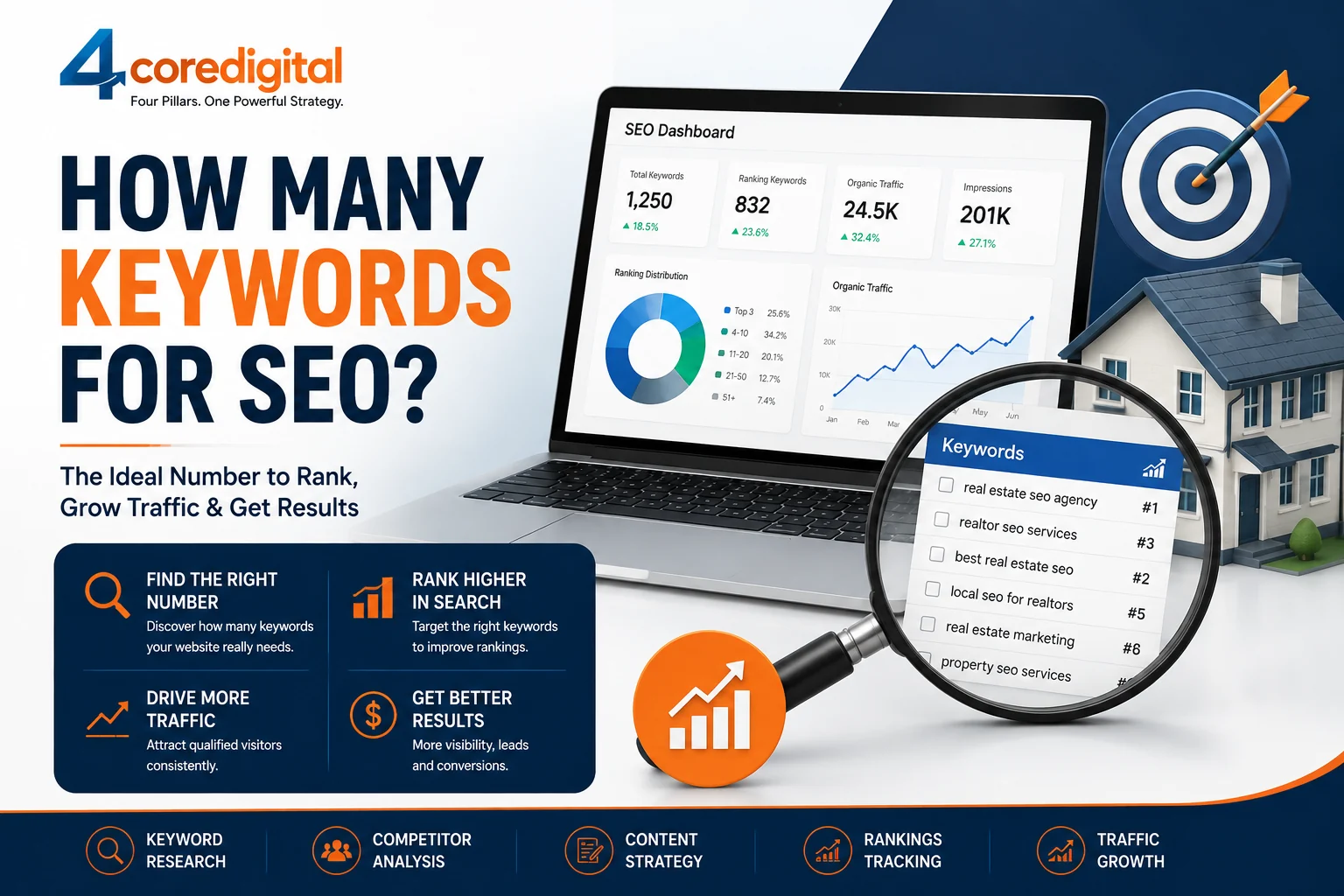

Quick Answer: How Many Keywords For SEO?
For most SEO pages, target one primary keyword and 3 to 8 closely related secondary keywords. A blog post can often target one main topic plus 5 to 15 related questions or long-tail variations. A full SEO campaign can target 10, 25, 50, 100 or more keywords, but those keywords should be grouped by search intent and mapped across different pages.
| Page Type | Recommended Keyword Focus |
|---|---|
| Homepage | 1 broad primary keyword + 5 to 10 brand/service variations |
| Service Page | 1 primary service keyword + 3 to 8 related keywords |
| Blog Post | 1 main topic + 5 to 15 related questions/long-tail keywords |
| Local SEO Page | 1 city/service keyword + local variations and nearby areas |
| Product Page | 1 product keyword + product features, model, use case and buying terms |
| Category Page | 1 category keyword + subcategory and product-type variations |
| Full SEO Campaign | 10 to 100+ keywords mapped across pages by intent |
What Does “How Many Keywords” Actually Mean?
When people ask how many keywords they should use for SEO, they usually mean one of three different things. Answering the right question first makes the rest of your keyword strategy much easier.
1. How many keywords should one page target?
This means choosing the main keyword and supporting keyword variations for a single page.
2. How many keywords should a website target?
This means building a keyword list across the full website, including services, products, locations, blogs and buyer questions.
3. How many keywords should an SEO campaign track?
This means choosing keywords to monitor in SEO reports, tools and monthly ranking updates.
One Primary Keyword Per Page Is Usually The Best Starting Point
For most SEO pages, one primary keyword is the best starting point. The primary keyword is the main search term the page is built around. It should match the page topic, the search intent and your business goal.
- A page about local SEO services should target local SEO services.
- A page about Shopify SEO should target Shopify SEO services.
- A page about SEO for startups should target SEO for startup companies.
- A page about SEO services in Los Angeles should target SEO services Los Angeles.
- A blog about how many keywords to use should target how many keywords for SEO.
Why one primary keyword works better
When one page has one clear primary keyword, it is easier to write a focused title tag, meta description, H1, headings, FAQs, internal links and CTA. It also helps search engines understand what the page is mainly about, which usually leads to better rankings for that keyword and its close variations.
What Are Secondary Keywords?
Secondary keywords are closely related terms that support the main topic. They help the page cover the topic naturally and answer more user questions without creating separate pages for every variation.
For the primary keyword how many keywords for SEO, natural secondary keywords include how many keywords should I use for SEO, how many keywords per page, how many SEO keywords per page, how many keywords for a blog post, how many keywords for local SEO, keyword mapping SEO and primary and secondary keywords SEO.
These keywords all belong to the same topic. They can naturally appear in headings, FAQs, examples, table sections and body content — that is very different from forcing unrelated keywords into the page.
How Many Keywords Should You Target Per Page?
Most pages should target one primary keyword and 3 to 8 secondary keywords. That is enough to cover the topic without turning the page into a keyword-stuffed mess.
| Page Type | Primary Keyword | Secondary Keywords | Notes |
|---|---|---|---|
| Homepage | 1 broad brand/service keyword | 5 to 10 variations | Keep broad but not vague |
| Service Page | 1 main service keyword | 3 to 8 related terms | Keep focused on one service |
| Blog Post | 1 main topic keyword | 5 to 15 related questions | Good for long-tail coverage |
| Local Page | 1 service + city keyword | 3 to 8 local variations | Add nearby areas naturally |
| Product Page | 1 product keyword | 3 to 8 buying terms | Include features and use cases |
| Category Page | 1 category keyword | 5 to 15 product variations | Good for eCommerce SEO |
| Case Study | 1 result/topic keyword | 3 to 5 supporting terms | Focus on proof and outcome |
How Many Keywords Should A Blog Post Target?
A blog post should usually target one main topic and several related questions or long-tail keywords. For most blogs, that means one primary keyword and 5 to 15 supporting keyword variations that share the same search intent.
For a blog targeting how many keywords for SEO, the same post can naturally answer how many keywords should I use for SEO, how many keywords per page is too many, should every page target one keyword, how many keywords should a blog post target, how many keywords should a local SEO page target, how do I avoid keyword stuffing, what is keyword cannibalization and how do I map keywords to pages.
This works because all those questions belong to the same search journey — the user wants practical guidance on keyword targeting. A strong blog can answer all of them in one helpful guide.
How Many Keywords Should A Service Page Target?
A service page should be more focused than a blog. It should usually target one main service keyword and 3 to 8 closely related service variations.
For example, a service page for technical SEO services can naturally target technical SEO services, technical SEO audit, crawlability optimization, indexing issue fixes, Core Web Vitals SEO, schema markup services and site speed SEO. These keywords all support the same service.
But if the same page also tries to target local SEO services, eCommerce SEO services and Google Ads management, the page becomes too broad. Those belong on separate service pages such as /services/local-seo, /services/ecommerce-seo and /services/google-ads.
How Many Keywords Should A Homepage Target?
Your homepage should not target every keyword your business cares about. It should usually target your broad brand and main business category, then internally link to deeper pages for specific services, industries and locations.
For 4Core Digital, the homepage naturally supports terms like SEO agency, SEO services, digital growth agency, AI SEO agency, local SEO agency, technical SEO agency and eCommerce SEO agency. The homepage acts like a hub — it introduces the business, builds trust and sends users to more focused pages.
Your service pages, industry pages, location pages and blogs should do the heavy lifting for specific keyword groups.
How Many Keywords Should A Local SEO Page Target?
A local SEO page should usually target one main service and one main location. Then it can include natural variations — nearby areas, neighborhoods, service-area terms and local questions.
A page targeting SEO services Los Angeles can also mention Los Angeles SEO agency, SEO company in Los Angeles, local SEO Los Angeles, Google Maps SEO Los Angeles, SEO consultant Los Angeles and SEO services near Downtown LA, Santa Monica, Hollywood and nearby areas.
The key is local relevance. A strong location page should not simply repeat the same content with a different city name. It should explain the local market, local customer intent, nearby areas, common business types and the services available in that location.
How Many Keywords Should An eCommerce Page Target?
For eCommerce SEO, the right number of keywords depends on the page type. A product page should be tightly focused. A category page can target more variations because users may search in different ways for the same product group.
| eCommerce Page Type | Keyword Focus |
|---|---|
| Product Page | 1 product keyword + features, model, use case and buying terms |
| Category Page | 1 category keyword + subcategory and product-type variations |
| Collection Page | 1 collection keyword + style, use case, brand or season terms |
| Blog Buying Guide | 1 main topic + related questions and comparison keywords |
How Many Keywords Should A Full SEO Campaign Target?
A full SEO campaign can target 10, 25, 50, 100 or more keywords depending on the website size, competition, budget, services, products, locations and content plan. The larger the website, the more keywords it can support — but only if each keyword is mapped to a useful page.
Small local business
- Target 10 to 25 keywords across main service pages, local service keywords, Google Maps keywords and common customer questions.
Growing service business
- Target 25 to 50 keywords across multiple services, locations, industry pages, blogs and comparison searches.
eCommerce website
- Target 50 to 200+ keywords across categories, product pages, collections, buying guides and comparison content.
SaaS or B2B website
- Target 50 to 150+ keywords across feature pages, use case pages, comparison pages, alternatives pages, blog clusters and integration pages. See /industries/seo-for-saas and /services/seo-for-startup-companies for how we structure SaaS keyword strategies.
Keyword Mapping: The Smart Way To Organize Keywords
Keyword mapping is the process of assigning each keyword or keyword group to the most relevant page on your website. It is one of the most important parts of SEO strategy because it prevents confusion and helps each page have a clear purpose.
| Keyword Group | Best Page Type |
|---|---|
| SEO agency | Homepage or main SEO service page |
| technical SEO services | Technical SEO service page |
| local SEO services | Local SEO service page |
| SEO services Los Angeles | Los Angeles location page |
| SEO for SaaS | SaaS industry page |
| Shopify SEO checklist | Blog post |
| eCommerce category page SEO | Blog guide or service support page |
| single page SEO services | Single Page SEO service page |
How Many Times Should You Use A Keyword On A Page?
There is no fixed number of times you need to repeat a keyword. You do not need to use the exact keyword 20 times to rank. Instead, use the keyword naturally in the places where it helps users and search engines understand the page.
- Title tag
- Meta description where useful
- H1 heading
- First paragraph
- One or two H2 headings where natural
- Body content
- Image alt text where relevant
- FAQ questions or answers
- Internal link anchor text
- URL slug where appropriate
Keyword Stuffing vs Natural Optimization
Keyword stuffing happens when a page repeats keywords unnaturally to try to manipulate rankings. It makes the page harder to read, reduces trust and creates a poor user experience.
Bad example: “Our SEO services are the best SEO services for businesses looking for SEO services because our SEO services help with SEO services.”
Better example: “Our SEO services help businesses improve search visibility through technical SEO, content strategy, on-page optimization, internal linking and clear performance tracking.”
The better version still explains the topic clearly, but it sounds natural. That is what good SEO should aim for.
Keyword Cannibalization: When Too Many Pages Target The Same Keyword
Keyword cannibalization happens when multiple pages on your website compete for the same keyword and search intent. It can confuse search engines and weaken your ranking potential.
For example, if you have several pages all trying to rank for local SEO services — a service page, a blog post, an “agency” page and a “for local business” page — Google may struggle to understand which one is the main page.
The solution is not always deleting pages. Sometimes you need to merge content, update internal links, change the keyword focus, add canonical tags or turn one page into a supporting blog that links to the main service page. Our /blog/website-not-ranking-after-seo-work guide walks through this in detail.
Signs of keyword cannibalization
- Two or more pages ranking for the same keyword
- Rankings keep switching between pages
- Traffic is split across similar pages
- Pages have similar titles and headings
- Multiple pages answer the same intent
- Internal links point to different pages using the same anchor text
90-Day Keyword Strategy For A New SEO Campaign
If you are starting SEO from scratch, do not try to target every keyword in the first month. A better approach is to build a 90-day keyword roadmap.
Days 1–30: Research and mapping
- Audit current rankings
- Review Google Search Console
- Analyze competitors
- Identify service, location and blog keywords
- Map primary keywords to existing pages
- Find keyword gaps
Days 31–60: Optimize priority pages
- Improve homepage metadata
- Optimize main service pages
- Improve high-impression pages
- Fix keyword cannibalization
- Add internal links
- Improve headings and content structure
- Create missing commercial pages
Days 61–90: Build supporting content
- Publish blog posts around customer questions
- Create local pages where relevant
- Improve category or product pages
- Build content clusters
- Track rankings and clicks
- Refine keyword targets based on data
Common Keyword Mistakes Businesses Make
Targeting too many keywords on one page
A page that tries to rank for everything often ranks for nothing meaningful.
Choosing keywords only by search volume
High volume does not always mean high value. Intent matters more than volume.
Ignoring long-tail keywords
Long-tail keywords often bring more qualified traffic because the user knows exactly what they want.
Creating duplicate location pages
Changing only the city name is not enough. Each location page needs useful local context.
Not mapping keywords to pages
A keyword list without page mapping does not create SEO growth.
Using the meta keywords tag
The old meta keywords tag is not used by Google for web ranking. Focus on visible content, metadata, headings, internal links and helpful page structure.
Tracking rankings but not leads
Rankings are useful, but SEO should also be connected to calls, forms, bookings, sales or enquiries — see /client-reviews and /case-studies for real examples.
Ignoring search intent
If your page does not match what the user wants, it will struggle even if the keyword appears many times.
Final Keyword Checklist
Before choosing keywords for SEO, work through this quick checklist for each important page.
- What is the main goal of this page?
- What is the primary keyword?
- What is the search intent?
- Is this keyword informational, commercial, local or transactional?
- What secondary keywords support the same intent?
- Does this keyword need its own page?
- Is another page already targeting this keyword?
- Can this page answer the user’s main questions?
- Does the page have a clear title and H1?
- Are internal links pointing to this page?
- Is the content helpful and readable?
- Is the CTA clear?
- Are rankings, clicks and conversions being tracked?
Final Thoughts: SEO Is Not About More Keywords
So, how many keywords should you use for SEO? For one page, usually one primary keyword and a small group of related secondary keywords. For one blog post, one main topic and several supporting questions. For a full campaign, as many keywords as your website can properly support with useful pages, strong internal links and clear search intent.
The best SEO strategy is not built by adding more keywords everywhere. It is built by choosing the right keywords, mapping them to the right pages, writing helpful content and tracking real business outcomes — the same approach we use inside /organic-seo, /services/organic-seo-consultant and every campaign in /case-studies.