
Quick Answer: Is SEO Still Worth It in 2026?
Yes — but the strategy has changed. Old SEO was often about keywords, backlinks and publishing content just to rank. Modern SEO is about building a complete organic growth system that helps your business appear in traditional Google results, Google Maps, AI-powered search experiences and the full buyer journey.
At 4Core Digital, we believe SEO is still one of the strongest long-term growth channels for businesses — but only when it is connected to real outcomes like qualified traffic, enquiries, calls, bookings, leads, sales and revenue.
Why People Think SEO Is Dead
Many business owners are confused about SEO because search has changed a lot. They see AI answers at the top of Google. They hear that fewer users are clicking through for simple informational queries. They notice competitors using AI content at scale. They may have paid for SEO before and received reports full of rankings but no real business growth.
Common questions business owners ask
- Is SEO still worth investing in?
- Will AI replace Google search?
- Are blogs still useful?
- Do backlinks still matter?
- Can SEO still generate leads?
- Should businesses focus only on paid ads or social media?
The real answer
These are valid questions. But the real answer is not "SEO is dead." The better answer is: low-quality, generic, task-based SEO is no longer enough. SEO still works, but it now needs stronger strategy, better content, technical clarity, authority, trust signals, conversion focus and AI search readiness.
What Has Changed in SEO in 2026?
SEO in 2026 is not the same as SEO from five or ten years ago. The biggest changes:
1. AI search is now part of the search journey
People are no longer only searching on Google and clicking blue links. They are also using Google AI Overviews, AI Mode, ChatGPT, Gemini, Perplexity and other AI-powered tools to research products, services and solutions.
Google's own guidance says SEO best practices continue to matter for its generative AI features because these experiences are rooted in Google's core Search ranking and quality systems. That means SEO is not disappearing. It is expanding.
2. Generic content is losing value
Publishing basic blog posts that say the same thing as every other website is not a strong SEO strategy anymore. Google recommends creating unique, helpful, people-first content that provides real value beyond common knowledge.
In simple words: your content needs to be useful, original and connected to what your audience actually wants to know before they buy, enquire or book.
3. Technical SEO still matters
AI search and modern Google search still need crawlable, indexable, well-structured websites. If Google cannot properly access, crawl, index or understand your pages, your visibility will suffer. Google also explains that pages need to be indexed and eligible to appear in Search with snippets to be eligible for generative AI features. Technical SEO is not optional — it is the foundation.
4. Search intent matters more than keywords alone
Ranking for a keyword is not enough if the page does not match what the user wants.
- What the user is searching for
- Why they are searching
- What stage of the buying journey they are in
- What information they need before taking action
- Which page should rank for that query
- How that page should convert the visitor
5. SEO must be connected to business outcomes
A business does not need "more traffic" if that traffic does not convert. In 2026, SEO should be measured by qualified organic traffic, leads, calls, bookings, demo requests, product sales, patient enquiries, consultation requests, quote requests and revenue opportunities. Rankings still matter, but they are not the final goal. The real goal is business growth.
Is SEO Still Worth It for Businesses in 2026?
Yes, SEO is still worth it in 2026 — especially for businesses that want long-term visibility and do not want to depend only on paid ads.
- Reach people already searching for your products or services
- Build trust before a customer contacts you
- Reduce long-term dependency on paid advertising
- Improve visibility across Google Search and AI search experiences
- Generate qualified traffic
- Support lead generation and sales
- Build authority in your niche
- Improve website structure and user experience
- Create a long-term growth channel
What SEO No Longer Means in 2026
SEO is no longer just:
- Adding keywords to a page
- Publishing random blogs
- Buying cheap backlinks
- Writing thin city pages
- Creating AI content at scale without value
- Sending monthly ranking screenshots
- Fixing meta titles and calling it a strategy
What SEO Means Now
In 2026, SEO means building a complete organic search system.
Search intelligence
Understanding what your customers search, what your competitors rank for and which keywords can actually generate business.
Technical SEO
Making sure your website can be crawled, indexed, understood and ranked properly. See our
Technical SEO Services for the full checklist.
On-page SEO
Optimising your pages around search intent, structure, headings, content, metadata, internal links and calls to action.
Content strategy
Creating helpful content that answers real customer questions and supports your important service, product or category pages.
Authority building
Building trust through backlinks, mentions, case studies, reviews, brand signals and relevant industry authority — the core of modern Link Building.
Conversion SEO
Making sure traffic turns into calls, forms, bookings, enquiries, demo requests or sales.
AI search readiness
Structuring your website, content and brand signals so your business has a better chance of being discovered in AI-powered search experiences. Learn more about AI SEO.
Why SEO Still Beats Many Short-Term Channels
SEO is not always the fastest channel, but it is one of the strongest long-term channels.
SEO is powerful because it reaches people when they are already searching. Someone searching "best SEO agency for SaaS," "emergency dentist near me," "Shopify SEO services," "roofing company in London," or "organic SEO consultant" already has intent. The job of SEO is to make sure your business appears when that intent exists.
| Channel | Main Strength | Main Limitation |
|---|---|---|
| Google Ads | Fast visibility | Traffic stops when budget stops |
| Social Media | Brand awareness | Demand is often low-intent |
| Referrals | High trust | Not fully scalable |
| Email Marketing | Good for existing audience | Needs list growth first |
| SEO | Captures existing search demand | Takes time and strategy |
The Type of SEO That Works in 2026
The businesses that win from SEO in 2026 are not necessarily the ones publishing the most content. They are the ones with the best strategy.
1. Service pages that match buying intent
Your service pages should clearly explain what you offer, who it is for, what problems you solve and why someone should contact you. For example, an Organic SEO page should not simply say "we improve rankings." It should explain how SEO helps generate qualified traffic, leads and revenue.
2. Location pages that are actually useful
City pages should not be copy-paste templates. They should explain what local clients get, how they benefit, which problems are fixed, which keywords matter and how results are measured. See Local SEO Services.
3. Industry pages that speak to real business problems
- A dental SEO page should talk about patient enquiries, treatment searches and Google Maps
- An HVAC SEO page should talk about service calls, emergency searches and booked jobs
- A SaaS SEO page should talk about demos, trials, signups and pipeline
- An attorney SEO page should talk about qualified case enquiries and consultations
4. Technical SEO that supports performance
A beautiful website can still fail if it has crawl issues, indexing problems, slow speed, poor mobile experience, duplicate content, broken links, poor internal linking, incorrect canonicals, missing structured data or weak site architecture. Technical SEO helps search engines and users move through the website properly.
5. Helpful content that builds authority
- How-to guides
- FAQs
- Comparison pages
- Service explainers
- Buying guides
- Problem-solution content
- Case studies
- Pricing guidance
- Location-specific content
- Industry-specific content
6. White-hat link building and brand authority
Backlinks still matter, but quality matters more than volume. A few relevant, trusted, editorial links can be more valuable than hundreds of spammy links.
- Digital PR
- Editorial placements
- Niche-relevant websites
- Resource links
- Brand mentions
- Guest posting with quality control
- Link reclamation
- Competitor backlink gap analysis
7. Better tracking and reporting
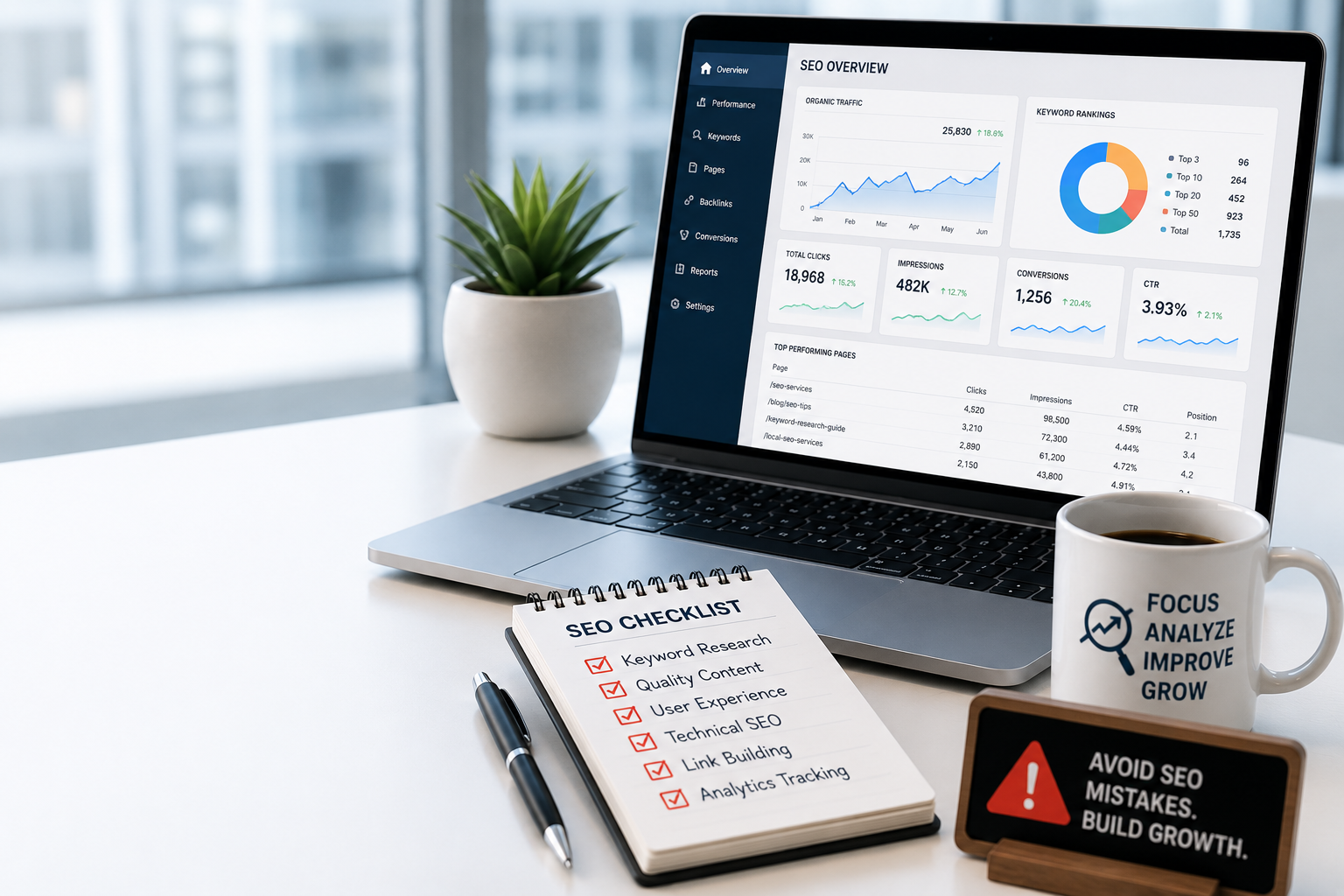
SEO reporting should not only show keyword rankings. A good SEO report shows what work was completed, which pages gained impressions and clicks, which keywords are moving, which technical issues were fixed, which content was improved, which leads came from organic traffic and what should happen next. SEO should feel clear, not mysterious.
SEO and AI Search: What Business Owners Need to Know
AI search is not a reason to stop SEO. It is a reason to do SEO better. Google explains that optimising for generative AI search is still part of optimising for the search experience, and that foundational SEO best practices continue to matter.
- Crawlable pages
- Indexable content
- Helpful information
- Clear headings
- Strong internal links
- Structured data where relevant
- Unique content
- Trust signals
- Product and service details
- Local business information where relevant
- Real expertise and proof
Should You Still Blog in 2026?
Yes, but not randomly. Blogging still works when it supports a strategy. A blog should help your business answer customer questions, support service pages, build topical authority, target long-tail keywords, improve internal linking, educate buyers, build trust, support AI search visibility and capture early-stage research queries.
Publishing generic posts like "10 Benefits of SEO" without a clear purpose will not be enough. Every blog should have a job.
Examples by business type
- A SaaS company can write comparison and use-case content
- A dental clinic can write treatment FAQs and patient question content
- A real estate business can write local area and valuation guides
- An ecommerce brand can write product, collection and buying guides
- A home service company can write emergency, repair and maintenance content
When SEO May Not Be Worth It
SEO is powerful, but it is not always the right immediate priority. SEO may not be the best short-term investment if:
- You need leads tomorrow and have no existing visibility
- Your website is not ready to convert visitors
- You cannot implement technical or content recommendations
- You want guaranteed rankings
- You only want cheap backlinks
- You are not willing to invest for at least 3 to 6 months
- Your offer, pricing or positioning is unclear
When SEO Is Definitely Worth It
SEO is worth investing in if:
- Your customers search on Google before buying
- You offer services, products or solutions with search demand
- Your competitors are getting traffic from organic search
- You want to reduce dependency on ads
- You want long-term visibility
- You want better quality leads
- You are willing to build content and authority
- You want to improve website performance
- You want a growth channel that compounds over time
What A Modern SEO Strategy Should Include in 2026
1. SEO audit
Review technical issues, content quality, rankings, competitors, backlinks, internal links and conversion paths.
2. Keyword research
Find keywords that match real buyer intent, not just search volume.
3. Keyword mapping
Assign the right keywords to the right pages.
4. Technical SEO
Fix crawlability, indexing, speed, redirects, canonicals, Core Web Vitals and site architecture.
5. On-page SEO
Improve titles, descriptions, headings, page copy, images, internal links and CTAs.
6. Content strategy
Create content that supports important service, product, location and industry pages.
7. Link building
Build authority through safe, relevant, white-hat methods.
8. Conversion improvements
Turn traffic into calls, forms, bookings, demos, enquiries or sales.
9. AI search optimisation
Make your content clear, helpful, structured and trustworthy for modern search experiences.
10. Monthly reporting
Track performance, explain progress and plan next steps.
How Long Does SEO Take in 2026?
SEO is not instant. Most businesses should think in stages:
| Timeline | What Usually Happens |
|---|---|
| Month 1 | Audit, research, technical fixes, on-page improvements and keyword mapping |
| Months 2–3 | Content improvements, content marketing, internal linking and link building |
| Months 4–6 | Content growth, authority building, stronger ranking movement and better traffic quality |
| 6+ Months | Scaling what works, expanding keywords, improving conversions and growing leads or sales |
So, Is SEO Still Worth It in 2026?
Yes. SEO is still worth it in 2026, but only if the strategy has changed with the search landscape.
The old approach was
- Add keywords
- Publish blogs
- Build links
- Send ranking reports
The modern approach is
- Understand search intent
- Build strong service and product pages
- Fix technical SEO
- Create helpful content
- Build authority
- Improve conversions
- Track business outcomes
- Prepare for AI-powered search
- Scale what generates real leads, sales and revenue
How 4Core Digital Can Help
At 4Core Digital, we help businesses build SEO strategies that connect rankings with real business growth. See our Case Studies for real client results.
- Organic SEO
- AI SEO
- Technical SEO
- Local SEO
- eCommerce SEO
- Shopify SEO
- SaaS SEO
- Industry SEO
- Location page SEO
- Content strategy
- Link Building
- Conversion-focused SEO
- Monthly SEO reporting