
What Is AI Search Visibility?
AI search visibility means your website is being surfaced inside AI-powered search experiences. This can include visibility in Google AI Overviews, Google AI Mode, generative AI features in Discover, AI-assisted search journeys, AI-powered answers that reference or surface web pages, and search experiences where users get summarised answers before clicking a result.
For business owners, this matters because users may no longer move through search results in the same old way. A potential customer may ask a longer, more specific question and get an AI-generated answer that highlights helpful sources.
Examples of AI-style queries
- "Best SEO strategy for a dental clinic in 2026"
- "How can a Shopify store improve organic sales?"
- "What should I check after a Google spam update?"
- "How do I track AI visibility in Search Console?"
- "Which SEO agency can help with AI search optimization?"
The important point
AI visibility is not just about impressions. It is about whether the right pages appear for the right questions, and whether that visibility supports real business outcomes — leads, calls, bookings and sales.
Why AI Search Visibility Matters in 2026
AI search visibility matters because the search journey is becoming more complex. In the past, users searched a keyword, scanned blue links, clicked one result and visited a website. Now, users may get a direct AI-generated answer, explore related questions, compare options inside the search experience and click only when they need deeper information.
What this can affect
- Organic clicks
- CTR
- Brand discovery
- Content visibility
- Informational traffic
- Product discovery
- Local business visibility
- Lead generation
- Buyer research journeys
Who benefits most
For some websites, AI search may reduce clicks for basic informational searches. For others, it may create new visibility opportunities because AI answers can highlight useful sources, pages, products, services and expert explanations.
The websites most likely to benefit are not the ones chasing shortcuts. They are the ones with strong technical foundations, useful content, clear expertise, structured information, strong internal links and real authority. Google's own guidance says SEO best practices continue to matter for generative AI search because these features are rooted in Google's core Search ranking and quality systems.
So no, SEO is not dead. But SEO reporting is changing.
What Changed in Google Search Console?
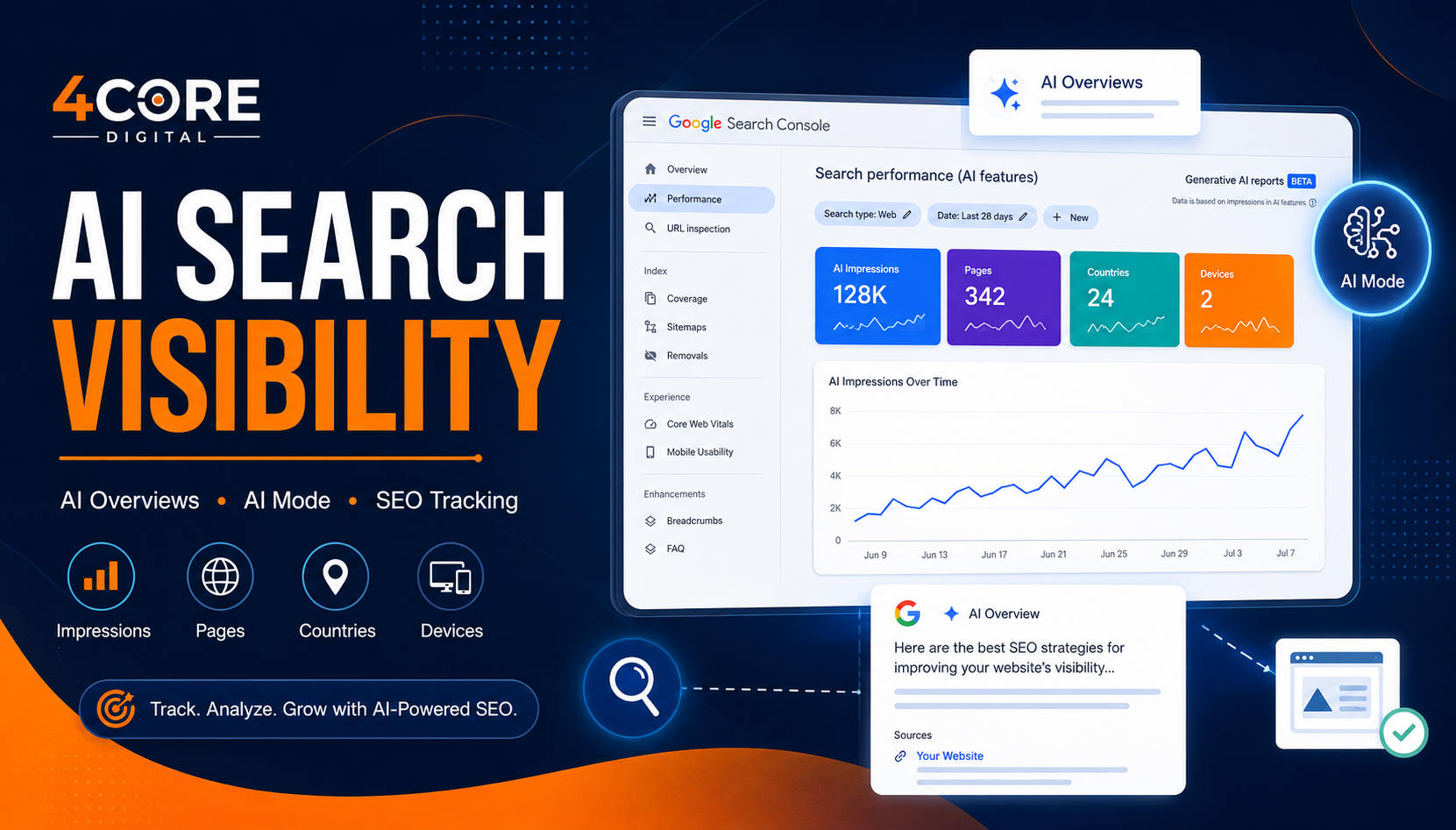
Google announced new Search Generative AI performance reports in Search Console on June 3, 2026. These reports are designed to give website owners dedicated views of their visibility inside generative AI features in Google Search, such as AI Overviews and AI Mode, as well as generative AI features in Discover.
Google also said this data is included in the overall performance report, while the new dedicated view helps site owners analyse generative AI visibility separately.
This is important because SEO teams and business owners have been asking a simple question: "How do I know if my website is appearing in AI search?" Before this type of reporting, many businesses had to rely on manual checks, third-party tools, traffic patterns and assumptions. Now, Search Console is starting to give more direct visibility into how pages appear in Google's generative AI features.
What Data Can You Track?
According to Google, the new generative AI performance reports can show information such as impressions, pages, countries, devices and dates. Google explains that impressions show how often URLs from your site appeared in generative AI features in Search and Discover.
The reports also let site owners check which URLs appeared, understand visibility by country, identify device usage for Search results, and monitor performance over time with hourly, daily, weekly and monthly granularity.
Better SEO questions to ask
- Which pages appeared in AI features?
- Which countries are seeing our AI visibility?
- Which devices are showing AI impressions?
- Did AI visibility grow after content improvements?
- Are our service pages or blog pages appearing more often?
- Are we visible for informational queries only, or also commercial ones?
- Are AI impressions helping brand visibility even if clicks are lower?
How To Check AI Visibility in Search Console
If your property has access to the new reports, start inside Google Search Console. Look for a dedicated generative AI performance report or view connected to Search and Discover performance.
1. Total AI impressions
Check whether your website is appearing in generative AI features at all. If impressions are increasing, Google may be surfacing more of your pages in AI-powered search experiences. If impressions are flat or zero, your website may need stronger content, better structure, improved crawlability or more authority.
2. Pages appearing in AI features
Go to the pages view and check which URLs are earning AI visibility. Group them by page type — homepage, service pages, industry pages, location pages, blog posts, product pages, category pages, case studies, guides and FAQs. This helps you understand what Google sees as useful for AI search.
3. Country-level visibility
Check countries to understand where your AI visibility is coming from. This is especially important for global businesses, SaaS companies, eCommerce stores, travel brands, agencies and international service providers. If you serve the UK, USA, Canada, Australia, India or other markets, country-level AI visibility can show which regions are growing.
4. Device visibility
Check whether visibility is coming from mobile or desktop. Mobile users may be more likely to search with conversational queries, local intent or quick decision-making needs.
5. Date comparison
- Last 7 days vs previous 7 days
- Last 28 days vs previous 28 days
- Before and after major content updates
- Before and after technical fixes
- Before and after Google updates
- Month-over-month growth
How To Read AI Search Impressions
AI search impressions should not be treated exactly like traditional organic clicks. A high number of AI impressions may mean your website is being surfaced in AI experiences, but it does not always mean users clicked through. That is why you should review AI visibility alongside other metrics.
Compare AI visibility with
- Normal Search Console impressions
- Organic clicks
- Average CTR
- Page-level traffic in GA4
- Landing page engagement
- Form submissions, calls, bookings and sales
- Demo requests
- Branded search growth
How to interpret patterns
If your blog posts are getting AI impressions but no leads, they may be useful for awareness. If your service pages are getting AI impressions and enquiries are increasing, that is more valuable. If your product pages are appearing in AI results and organic revenue improves, that is a stronger commercial signal.
The goal is not just visibility. The goal is qualified visibility.
Which Pages Should You Analyse First?
Not every page matters equally. Start with pages that can influence business growth.
Service pages
- Organic SEO services
- Local SEO services
- Technical SEO services
- AI SEO services
- Link building services
Industry pages
- SEO services for dentists
- SEO for HVAC companies
- SEO for SaaS
- Attorney SEO services
- Real estate SEO
Location pages
- SEO services London
- SEO services Manchester
- SEO services New York
- SEO services Toronto
- SEO services Sydney
Blog posts
- How to track AI search visibility
- What is AI SEO?
- How to fix ranking drops after a Google update
- How to improve Google Business Profile visibility
Case studies
Case studies can support trust because they show real results, process and proof. If AI-powered search experiences are surfacing brands with proof and credibility, case studies become more important.
How AI Search Visibility Connects With Organic SEO
AI SEO should not be separated from normal SEO. Google says generative AI features on Search are rooted in core Search ranking and quality systems. That means the foundations still matter — useful content, crawlability, indexability, structure, page experience and relevance.
So instead of thinking "we need a separate AI SEO hack", think "we need stronger SEO foundations that also support AI search visibility".
Foundations that support AI visibility
- Helpful content
- Strong page structure
- Clear headings
- Useful FAQs
- Technical SEO
- Internal linking
- Schema where relevant
- Crawlable and indexable pages
- Strong topical authority
- Real business details
- Trust signals, case studies and reviews
- Original insights
What To Do If You Are Not Appearing in AI Results
If your website is not appearing in AI search reports, do not start creating hundreds of thin AI-targeted pages. Start with diagnosis.
Check if your website has access to the report
Google is rolling the reports out gradually, so your website may simply not have access yet.
Check whether your pages are indexed
- Indexing status
- Canonical selection
- Crawled but not indexed pages
- Discovered but not indexed pages
- Noindex tags
- Robots.txt blocks
- Sitemap inclusion
Check whether your content is useful enough
A page that simply repeats generic information may struggle. Google's AI guidance encourages unique, helpful, reliable, people-first content and warns against simply recycling what already exists online.
Check whether the page answers real questions
- What is the service?
- Who is it for?
- What problem does it solve?
- What does the client get?
- How does the process work?
- What should someone check first?
- What results are realistic?
- What are the next steps?
Check whether your page has trust signals
- Case studies
- Reviews
- Experience
- Process
- Author details
- Business details
- Examples and FAQs
- Clear contact options
Content Checks for AI Search Visibility
Content quality is one of the biggest opportunities for AI search visibility. Google's guidance says unique, compelling and useful content can influence a website's presence in generative AI search over the long run, especially when it provides a unique point of view instead of only summarising what already exists.
Is the content original?
- First-hand examples
- Practical advice
- Real process
- Industry-specific insights
- Common mistakes
- Case study references
- Screenshots or visuals where helpful
- Clear recommendations
Is the content organised clearly?
- Clear H2s and H3s
- Short paragraphs
- Tables
- FAQs
- Step-by-step sections
- Checklists
- Examples
- Summary boxes
Does it answer buyer questions?
For service pages, answer: what do I get, how long does it take, what problems do you fix, how do you measure success, why should I choose you, what is included and what should I do first.
For eCommerce pages, answer: what is this product, who is it best for, what sizes, features or options matter, how does it compare, what makes it trustworthy, and what delivery or return details matter.
For local pages, answer: which area do you serve, what local problems do you solve, what services are available locally and how can someone contact or book.
Does the page include proof?
- Results
- Reviews
- Case studies
- Process
- Team experience
- Screenshots
- Before/after examples
- Certifications
- Client outcomes
- Transparent reporting
Technical SEO Checks for AI Search Visibility
AI visibility still depends on technical SEO. Google explains that the way Search finds and processes pages remains central to how its AI systems access data. Google also says a page must be indexed and eligible to be shown in Search with a snippet to be eligible for generative AI features.
Crawlability
- Robots.txt
- Internal links
- XML sitemap
- Crawl errors
- JavaScript rendering
- Blocked resources
Indexability
- Noindex tags
- Canonicals
- Duplicate URLs
- Soft 404s
- Thin indexed pages
- Sitemap status
- URL Inspection Tool
Page structure
Use clean headings and readable sections. A page should be easy for humans and search engines to understand.
Internal linking
Important pages should not be orphaned. Link from the homepage, service pages, blog posts, related guides, industry pages, location pages and case studies.
Schema markup
- Organization schema
- Service schema
- FAQPage schema
- Breadcrumb schema
- Product schema
- Article schema
- LocalBusiness schema where relevant
Page experience
Google's guidance also mentions good page experience, including display across devices, reduced latency and making main content easy to distinguish. Check mobile usability, Core Web Vitals, speed, layout stability, popups, readability and clear CTAs.
Local Business and eCommerce AI Visibility
AI search visibility is not only for blogs. It can also matter for local businesses and eCommerce stores. Google says generative AI responses can include product listings, product information and local business information where appropriate. Google also points to Merchant Center and Google Business Profiles as ways to help products and services appear in Google Search experiences.
For local businesses
- Google Business Profile
- Services and categories
- Reviews and photos
- Business description
- Local landing pages
- NAP consistency
- Local schema
- FAQs
- Service-area pages
For eCommerce stores
- Product feeds
- Product schema
- Category pages
- Product descriptions
- Reviews and FAQs
- Images
- Shipping details
- Return policy
- Collection pages and internal linking
What Not To Do for AI SEO
AI search has created many new terms: AEO, GEO, AI SEO, answer engine optimisation, generative engine optimisation and more. Some of these ideas are useful. Some are just rebranded SEO. Some are hype.
Do not create hundreds of thin AI pages
Google warns that creating separate content for every possible query variation mainly to manipulate rankings or generative AI responses can violate scaled content abuse policies.
Do not rewrite everything only for AI
Google says you do not need to write in a specific way just for generative AI search because AI systems can understand synonyms and general meanings. Write for people first.
Do not ignore traditional SEO
- Crawlability
- Indexing
- Helpful content
- Authority
- Internal linking
- Page experience
- Search intent
- Clear structure
Do not add fake schema
Only add schema that matches visible content. Do not fake reviews, ratings, FAQs, product details, local business information, medical or legal claims, or case study results.
Do not chase shortcuts
There is no magic AI SEO shortcut. The safer approach is to improve content, improve technical SEO, build authority, add proof, strengthen internal links, track visibility and improve pages based on data.
90-Day AI Search Visibility Action Plan
If you want to improve AI search visibility, use a structured plan. Do not change everything randomly.
First 30 days: audit and foundation
- Check Search Console AI visibility reports if available
- Review normal Search Console performance
- Identify top pages by impressions and clicks
- Check indexed pages
- Review crawlability
- Check noindex and canonical issues
- Review service pages and blog content
- Review internal linking
- Check schema
- Identify thin or generic pages
- Create an AI visibility improvement roadmap
Days 31–60: content and structure improvements
- Rewrite thin pages
- Improve headings and structure
- Add FAQs where useful
- Add better examples
- Add trust sections
- Strengthen service pages
- Improve blog posts
- Add internal links
- Update metadata
- Add schema where relevant
- Improve page experience
- Add helpful images or videos where useful
Days 61–90: authority, reporting and scaling
- Track AI search impressions if available
- Compare page visibility before and after updates
- Review countries and devices
- Improve high-potential pages further
- Build internal links from supporting content
- Create new content around real buyer questions
- Improve Google Business Profile or Merchant Center where relevant
- Build authority with white-hat link building
- Track leads, calls, bookings or sales where possible
- Plan the next 90 days based on data
AI SEO Checklist
Use this checklist to review your website across Search Console, content, technical SEO, trust and conversion.
Search Console checks
- Do you have access to generative AI performance reports?
- Are AI impressions visible?
- Which pages appear in AI features?
- Which countries and devices show AI visibility?
- Are impressions increasing or decreasing?
- Did visibility change after content updates?
Content checks
- Does the page answer real user questions?
- Is the content original and useful?
- Does it provide a unique point of view?
- Is it organised with clear headings?
- Does it include examples and FAQs?
- Does it avoid generic copied information?
- Does it guide users to a next step?
Technical SEO checks
- Is the page crawlable and indexable?
- Is the canonical correct?
- Is the page included in the sitemap?
- Are important pages internally linked?
- Are there schema opportunities?
- Does the page load well on mobile?
- Is the main content easy to read?
Trust checks
- Is the author or business clear?
- Are services explained properly?
- Are case studies visible?
- Are reviews or proof added where real?
- Is contact information easy to find?
- Are claims accurate and realistic?
Conversion checks
- Is there a clear CTA?
- Can users call, book or submit a form easily?
- Are forms simple?
- Are CTAs placed after key sections?
- Are commercial pages connected to supporting blogs?
- Are leads tracked in GA4 or CRM where possible?
Final Thoughts
AI search visibility is becoming an important part of SEO reporting in 2026. Google's new generative AI performance reports in Search Console give website owners a better way to understand whether their pages are appearing in AI Overviews, AI Mode and other AI-powered search features. But the strategy should not be panic, hype or shortcuts.
The best approach is still practical SEO: create helpful content, make pages crawlable and indexable, improve technical structure, answer real buyer questions, build topical authority, add trust and proof, strengthen internal links, track Search Console data and improve pages based on performance.
The goal is not just to appear in AI results. The goal is to build visibility that supports real business growth — qualified traffic, leads, enquiries, calls, bookings, sales and revenue. Explore our /services/ai-seo, /services/technical-seo and /blog/google-june-2026-spam-update guides for related next steps, or /contact us for a free AI SEO audit.