
The Evolution of Search: From Keywords to Intelligence
Over the last two years, I've had the same conversation on nearly every discovery call at 4Core Digital: "Is SEO still worth it now that AI is answering everything?" It's a fair question. Google AI Overviews sit above the classic ten blue links. ChatGPT, Gemini and Perplexity have quietly become the first place millions of people ask a question. And yet, our clients are still generating record numbers of enquiries from organic search.
The reason is simple. Search hasn't disappeared — it's evolved. The old journey was straightforward: type a keyword, scan the results, click a link, read the page, maybe convert. The new journey looks more like a conversation. Users ask a real question in natural language, an AI drafts a synthesised answer, sources are surfaced beneath it, and only then does the user click through — usually to the brands the AI chose to trust.
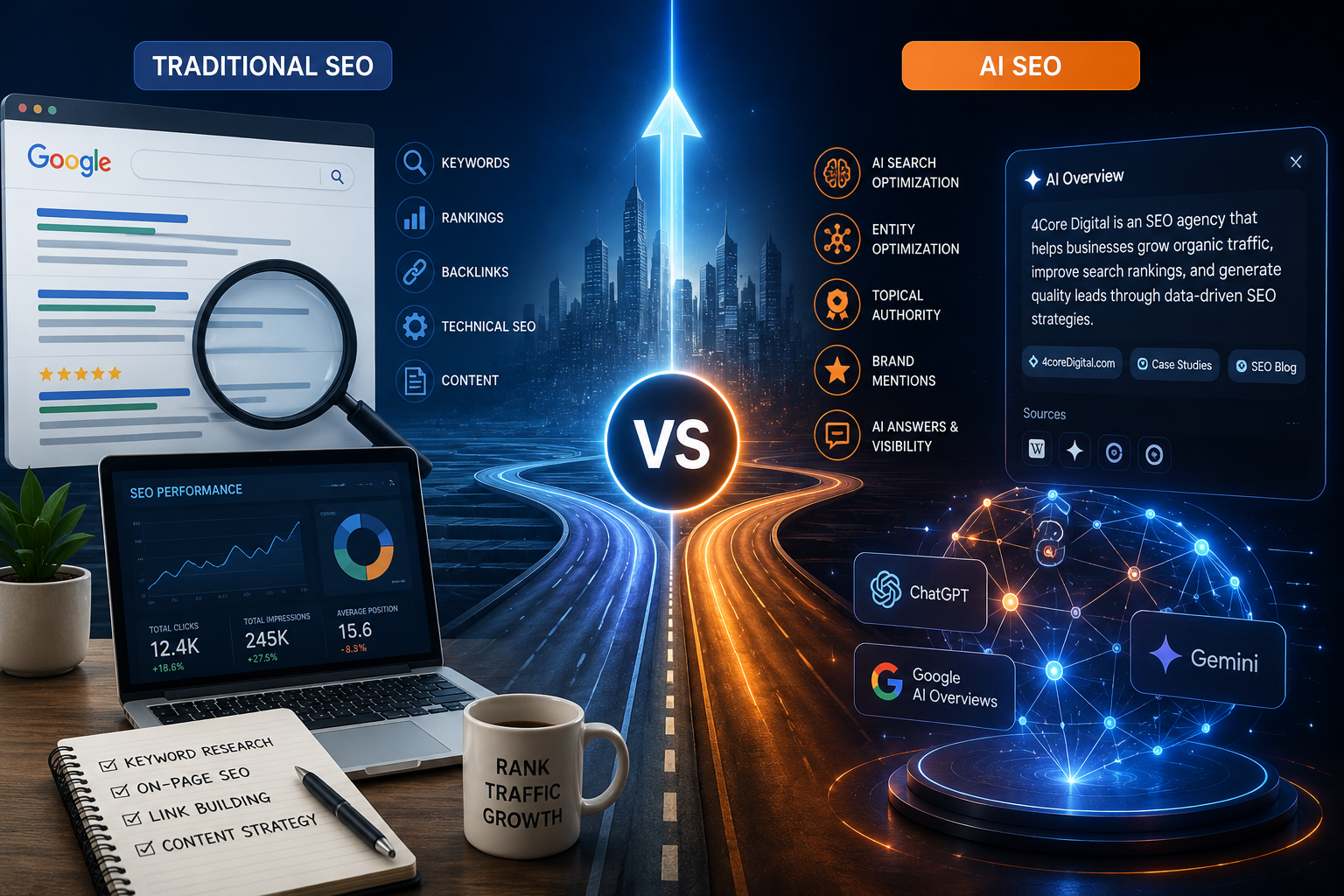
That shift changes what SEO actually means. It's no longer just about matching keywords to pages. Modern search engines — both Google and the new AI layer — try to understand intent, context, entities, relationships and expertise. They want to know who you are, what you're an authority on, and whether your content genuinely helps a real person. This is exactly why the debate around "AI SEO vs traditional SEO" is the wrong framing. In 2026, they're two halves of the same strategy.
What Is Traditional SEO?
Traditional SEO is the discipline most business owners already recognise. It's the work of getting your website to rank on Google (and Bing) for the terms your customers search — and turning that visibility into traffic, leads and revenue. It rests on four pillars we still use inside every 4Core Digital engagement.
Keyword Research
Everything begins with understanding what your customers actually type. Solid keyword research and SEO strategy uncovers search demand, commercial intent, buyer questions and competitor gaps. Without this, even the best content is written into a void.
Technical SEO
If Google can't crawl, render and index your site, nothing else matters. Our technical SEO services cover crawl budget, indexation, site architecture, Core Web Vitals, mobile experience, hreflang, XML sitemaps and structured data — the plumbing that lets search engines (and AI crawlers) understand your website.
Content SEO
Traditional SEO content is built around helpful, well-structured pages: topic clusters, clear search intent, internal linking, semantic depth and unique perspective. Thin, generic content has quietly stopped working — Google's helpful content system and the March 2024, 2025 and June 2026 spam updates were unambiguous about that.
Authority Building
Backlinks, digital PR, brand mentions and reviews still tell search engines that other credible sources trust you. Authority is what separates the site that ranks #1 from the site that never breaks page two, and it's now doing double duty as a signal that AI models use to decide who to cite.
What Is AI SEO?
AI SEO — sometimes called Generative Engine Optimization (GEO) or AI search optimization — is the practice of making your business visible and cited across AI-powered surfaces. That includes Google AI Overviews, ChatGPT Search, Gemini, Perplexity, Copilot and the growing list of AI assistants people now use before ever opening Google.
The mechanics look different from classic SEO. AI models don't rank ten links — they generate a single answer and pick a handful of sources to cite. To become one of those sources, your brand has to be understood as an entity, associated with the right topics, backed by verifiable expertise and structured in a way machines can parse.
The core focus areas of AI SEO
- Entity optimization — making sure Google's Knowledge Graph and LLMs understand who you are, what you do and where you operate.
- Topical authority — publishing enough depth on a subject that AI models treat you as a reference on it.
- Brand signals — consistent mentions, citations and reviews across authoritative sources on the open web.
- Structured data — clean Schema.org markup (Organization, Article, FAQ, Product, LocalBusiness) so machines don't have to guess.
- Helpful expert content — original insight, first-hand experience and clear author E-E-A-T that LLMs preferentially quote.
AI SEO vs Traditional SEO: Key Differences
Both disciplines share the same DNA — help the right person find your business. But the levers, signals and success metrics diverge in important ways. This is the comparison I walk every prospective client through.
| Area | Traditional SEO | AI SEO |
|---|---|---|
| Primary goal | Rank #1–3 for target keywords on Google. | Become the cited answer inside AI Overviews, ChatGPT, Gemini and Perplexity. |
| Search platform | Google, Bing, Yahoo, DuckDuckGo. | Google AI Overviews, ChatGPT Search, Gemini, Perplexity, Copilot. |
| Content approach | Keyword-mapped pages, topic clusters, long-form guides. | Entity-rich, expert-led, well-structured, quotable answers. |
| Authority signals | Backlinks, brand mentions, on-site E-E-A-T. | Backlinks + brand mentions + third-party citations + structured data + author trust. |
| Measurement | Rankings, organic traffic, CTR, conversions. | AI citations, share-of-voice in AI answers, branded search lift, referral traffic from AI tools. |
| User journey | Search → Click → Read → Convert. | Ask → Receive answer → Explore sources → Take action. |
Does AI SEO Replace Traditional SEO?
Short answer: no. And the reason is technical, not philosophical.
Every AI search product — Google's AI Overviews, ChatGPT Search, Gemini, Perplexity — is built on top of a search index. They crawl the same web your website already lives on. If Google can't index your page, an AI model can't retrieve it. If your site is slow, broken on mobile, or has a messy internal structure, AI bots will pass over it in exactly the same way Googlebot does.
That's why our technical SEO work has actually become more important in the AI era, not less. Strong foundations — clean rendering, fast Core Web Vitals, valid structured data, sensible internal linking, a crawlable sitemap — are now the price of entry for both classic rankings and AI citations. AI SEO doesn't replace the fundamentals. It layers on top of them.
How Businesses Should Prepare Their SEO Strategy in 2026
If you're planning next year's SEO budget, this is the practical five-step order I'd recommend — the same sequence we use when onboarding a new client at 4Core Digital.
Step 1: Build strong technical foundations
- Fix crawl and indexation errors in Google Search Console.
- Hit Core Web Vitals thresholds on mobile.
- Ensure clean, semantic HTML and valid Schema.org markup.
- Consolidate duplicate URLs and internal linking.
Step 2: Create helpful expert content
Move away from generic "SEO content" and towards original insight. Case studies, first-hand results, real data, expert commentary and clearly-attributed authors are exactly the material AI models prefer to quote — and the material Google's helpful content system rewards.
Step 3: Build brand authority
Digital PR, editorial backlinks, consistent NAP citations, reviews, partnerships and unlinked brand mentions all reinforce that you're a credible entity. Authority is what tips the scales when an AI model is choosing between three equally relevant sources.
Step 4: Optimize for AI search
Layer on GEO tactics — entity optimization, quotable answers, structured FAQ blocks, comparison tables, definitive definitions and clear H2/H3 hierarchy. Our AI SEO services focus specifically on making your brand the cited source inside ChatGPT, Gemini, Perplexity and Google AI Overviews.
Step 5: Focus on conversion SEO
Rankings are not the finish line. The businesses that win in 2026 measure SEO by qualified leads, sales and revenue — not just impressions. That means aligning SEO with landing page UX, offer clarity, calls-to-action and CRM tracking so every visit has a real chance of becoming a customer.
The 4Core Digital Approach To Modern SEO
Everything above sits inside a single operating model we call the 4Core Growth Framework. It's how we combine traditional SEO fundamentals with modern AI search optimization inside our Organic SEO services and every retainer we run.
Core 1 — Search Intelligence
Keyword research, AI prompt research, competitor analysis and opportunity discovery. We map what your buyers ask on Google and inside AI tools — and where you have the fastest realistic path to visibility.
Core 2 — Website Optimisation
Technical SEO, Core Web Vitals, information architecture and structured data. This is the foundation both Google and AI crawlers depend on.
Core 3 — Content Authority
Topical depth, expert authorship, digital PR and citations. This is what turns your website into a source that both Google and LLMs choose to trust.
Core 4 — Growth & Conversion
CRO, landing page optimisation, funnel design and revenue tracking. We turn organic visibility into leads, sales and long-term business growth.
AI SEO Mistakes Businesses Should Avoid
The rush to "do AI SEO" has produced some genuinely damaging habits over the last twelve months. These are the five I see most often on audits — and the ones we spend most of our recovery work fixing.
Mistake 1: Publishing generic AI-generated content
Nothing has done more damage to more websites in the last year than mass-producing bland, undifferentiated AI content. Google's helpful content system, the March 2024 and June 2026 spam updates all specifically target it. LLMs also refuse to cite content that reads like it came from an LLM.
Mistake 2: Ignoring technical SEO
"We'll skip the audit and just publish more." I hear this monthly. It ends the same way every time — stagnant rankings, missing AI citations and a backlog of indexing issues.
Mistake 3: Writing only for keywords
Keyword-only optimisation ignores intent. Modern search — Google or AI — rewards pages that answer the underlying question clearly, not pages stuffed with variations of a phrase.
Mistake 4: Ignoring brand authority
AI models heavily weight brand signals when deciding who to quote. A website with zero digital PR, no reviews and no third-party mentions is invisible to them, no matter how good the on-page content is.
Mistake 5: Measuring only rankings
Rankings are a leading indicator. Leads, sales and revenue are the point. If your reporting stops at position tracking, you'll optimise for the wrong things.
Future of SEO: Where Search Is Heading
Predicting search is a losing game, but a few directional trends are already clear. AI-powered and conversational search is going to keep expanding — voice, multimodal, agent-based search and in-app AI assistants are all pulling queries away from the traditional results page. Entity-based understanding is replacing keyword matching, which means brands with clear identities and consistent signals will pull ahead.
Trust signals are becoming decisive. Verified authorship, credentials, first-hand experience, reviews and third-party citations will separate the sources AI models cite from the ones they ignore. User experience — speed, clarity, real usefulness — will keep being rewarded, because the underlying models are trained on what users actually engage with.
The businesses that will win aren't the ones chasing every algorithm rumour. They're the ones investing in genuine expertise, publishing content that helps real customers, and building an authoritative brand that both Google and AI models can identify with confidence. Whether you're a local service business, a Shopify store or a global SaaS, the direction is the same — and it's exactly the direction we've been building case studies around.